
Earned wage access (EWA) is a workplace financial benefit that lets employees access wages they have already earned before their scheduled payday. The money is not an advance on future pay. It reflects earnings for hours already worked, made available days or weeks earlier than a standard payroll calendar would deliver it.
The benefit has moved from fintech novelty to mainstream payroll infrastructure in a little over a decade. A 2024 CFPB analysis of employer-partnered paycheck advance products found that more than 7 million workers accessed approximately $22 billion through these programs in 2022, and that transaction volume grew by over 90% between 2021 and 2022. (see disclosure 1) In December 2025, the Consumer Financial Protection Bureau issued an advisory opinion confirming that earned wage access products meeting its "Covered EWA" criteria are not credit under the Truth in Lending Act, resolving years of regulatory uncertainty for employers. (see disclosure 2)
This article covers the full landscape: what earned wage access means, how it works, the models behind it, what employees and employers get from it, its legal status, its history, the apps and platforms that deliver it, and how adoption differs across industries.
What Earned Wage Access Means
Earned wage access refers to any service that gives workers on-demand access to wages they have accrued during the current pay period, ahead of payday. The industry and regulators also use the terms on-demand pay, early wage access, and instant pay. In HR and payroll contexts, EWA is the standard abbreviation.
The definitional detail that matters most is the word "earned." An EWA balance is calculated from hours already worked and verified through payroll or time-and-attendance data. That is what separates earned wage access from payday loans, cash advance apps, and other products that lend against income a worker expects to receive but has not yet earned.
The benefit exists because pay frequency has not kept pace with how expenses arrive. As the CFPB noted in the Federal Register, nearly three-quarters of nonfarm payroll employees are paid biweekly or even less frequently. (see disclosure 2) According to PayrollOrg research, 78% of workers would face financial difficulties if their paychecks were delayed. (see disclosure 3) The household math backs that up: in the Federal Reserve's Survey of Household Economics and Decisionmaking, 37% of adults said they would not cover a hypothetical $400 emergency expense exclusively with cash or its equivalent. (see disclosure 4) Earned wage access closes the timing gap between when income is earned and when it is available.
How Earned Wage Access Works
From the employee's side, earned wage access is deliberately simple. An employee picks up a Saturday shift and earns $120. That evening, the app already shows the new earnings in an available balance. On Tuesday a utility bill lands, so they move $60 of their earned pay to their account, instantly or by the next business day. When payday arrives, the paycheck simply reflects what was already taken. There is nothing to apply for, no interest running, and no bill coming later, because it was their money the whole time.
The quiet breakthrough that makes all of this possible is not the movement of money. It is the digital representation of a worker's earnings in real time. Pay data traditionally sat in unconnected HR systems, unverified until payroll ran; EWA providers solved that interoperability problem and underwrote the accuracy risk, producing a balance a worker can rely on as money in the bank.
Types of Earned Wage Access: B2B and B2C Models
Earned wage access is delivered through two dominant models: employer-integrated earned wage access, often shortened to B2B EWA, and direct-to-consumer earned wage access, or D2C EWA (also known as B2C). Both provide the same core capability, access to wages already earned before payday. The difference lies in delivery, integration, cost structure, and governance.
Employer-integrated EWA operates through direct payroll and HR system integration. Available amounts are based on employer payroll records, the program is offered as an employer-sponsored benefit, and employers set eligibility rules and usage parameters. This is also the model the CFPB's Covered EWA definition describes. Direct-to-consumer EWA operates independently of employer payroll systems: individuals enroll directly through consumer financial apps, earned wages are determined through methods such as bank account connections or income estimation, and any fees or subscription costs are paid by the user. It gives workers access regardless of whether their employer offers EWA as a benefit, with continuity across jobs.
A full breakdown of employer-integrated vs. direct-to-consumer earned wage access covers how the two compare across payroll integration, sponsorship, wage verification, and employee experience. The rest of this article focuses on the employer-integrated model, since that is the version HR, benefits, and payroll leaders evaluate and administer.
What Happens Behind the Scenes
Underneath that experience, every employer-integrated program runs the same three-step loop:
• Verify. The provider connects to the employer's payroll and time-and-attendance systems and calculates an available balance from confirmed hours worked, typically capped at a percentage of estimated net earnings. The employer may set the cap and eligibility rules.
• Deliver. The employee requests any amount up to the balance and receives it by standard transfer, typically free, or by instant transfer, which some providers include at no cost and others price as an expedited fee.
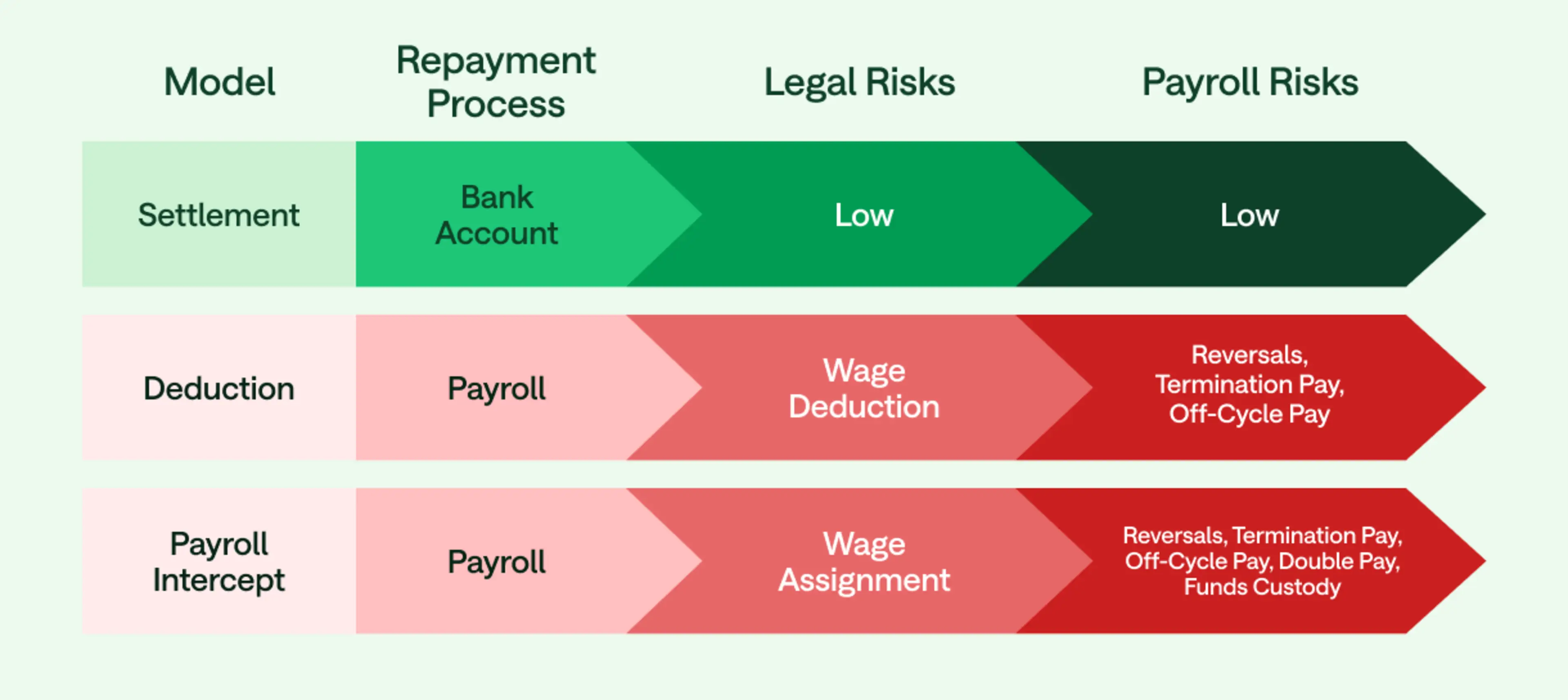
• Settle. When payroll runs, the accessed wages are reconciled through one of three models: a deduction from the next paycheck (the “Deduction Model”), an intercept in which wages route through the provider (the “Intercept Model”), or a settlement in the employee's own bank account after the full paycheck lands (the “Settlement Model”). The choice of repayment model carries real compliance weight under earned wage access laws and regulations.
While the Settlement Model operates outside of payroll, the Deduction and Intercept Models can introduce new risks to employers surrounding:
Wage assignments and wage deductions - these payroll repayment models could create a risk that a state may deem the model akin to a wage assignment or improper wage deduction in that state. These laws often involve gray areas. For example, some states like California have wage assignment provisions in the labor code as well as the lending code. Some states have both wage deduction and wage assignment laws that could separately be implicated. These laws can impact both the employer and the EWA provider.
Lack of paystub integrity - employees no longer receiving their full paychecks in their bank accounts.
Payroll burden - edge cases like termination pay, reversal, and off-cycle pay can be more burdensome when an EWA provider needs to be repaid.
“The deduction and payroll intercept models carry risk in states with wage assignment or improper wage deduction statutes, an area where legal review before launch is essential.”
—Christopher Wood, CPP, Thomson Reuters Checkpoint (see disclosure 5)
When EWA is offered as a free bank account feature, the employer is removed from the repayment process. This means no added legal or operational risks for the payroll department. Instead, the employer can deliver 100% of the paycheck to the employee's bank account, where repayment occurs through the Settlement Model. This technology development frees payroll departments from manual processes like dealing with EWA reversals, termination pay, and off-cycle pay.
Earned Wage Access Benefits for Employees
For workers, the benefits cluster around control, cost, and momentum toward better financial health:
• Control over pay timing. Employees choose when their pay arrives and where it goes, and can watch earnings accrue in real time, which supports day-to-day budgeting in a way a biweekly paystub cannot.
• Fewer late fees and less reliance on high-cost alternatives. Accessing earned pay when a bill is due helps workers avoid late fees, overdrafts, and payday borrowing, the products EWA was built to displace.
• A lower-cost source of liquidity. Per the CFPB's Data Spotlight on the paycheck advance market, the average EWA transaction fee paid by workers was $3.18. (see disclosure 6) That compares favorably to fee-based overdraft and payday lending, and the benchmark keeps falling as zero-fee EWA becomes the direction of employer adoption.
• A path beyond access. When wage access is delivered inside a broader platform, it becomes the entry point to savings, credit building, and spending insight rather than a standalone transaction.
While nearly every provider, if not all, offer a free transfer option, these free options are utilized infrequently. The strongest version of the employee benefit is the one with no price tag at all, even for instant transfers. For example, EWA can be free when included in a banking platform that has alternative sources of revenue like merchant-funded interchange. Independent research analyst Everest Group has called this the future of EWA.
Earned Wage Access Benefits for Employers
The employer case rests on recruiting, retention, productivity, and cost:
• Recruiting. In a study cited by the Kansas City Federal Reserve, 96% of employers offering EWA said they believe it helps with recruiting. (see disclosure 7) More recently, 74% of workers say their job is more appealing if they are able to access their wages sooner. (see disclosure 8)
• Retention. An older 2022 Harvard Business School study of the EWA provider Minu found users had a 12% lower likelihood of leaving in the next pay cycle than non-users, moderating to a 5% effect after eight months. (see disclosure 9)
• Productivity. Financial stress is the mechanism behind both outcomes: research estimates it can distract employees for 7.3 hours a week, contributing to $183 billion in lost productivity. (see disclosure 10)
• Minimal cost and payroll lift. Employer-integrated EWA is one of very few benefits employers typically do not fund, since the provider fronts accessed wages, and settlement-based configurations leave the payroll run untouched.
An important caveat is that access alone does not guarantee financial progress. Employers increasingly judge programs on outcomes rather than transaction usage. According to Everest Group, there is a measurement gap with 8 out of 10 employers struggling to measure financial wellness ROI. (see disclosure 11) As a result, some providers now offer free employer dashboards that measure workforce financial health metrics like savings growth and credit growth. The best indicator of whether a program is working is if employees are growing their savings.
In most employer-partnered programs the provider fronts the money from its own capital, so the employer never pre-funds accessed wages and payroll runs on its normal calendar. The employer's role is limited to the data integration and program configuration, except when either the Deduction Model or Intercept Model is used. In those instances, the employer is also involved in repayment.
Earned Wage Access Laws and Regulations
Earned wage access is mostly governed on two levels: a federal baseline led by the CFPB and a fast-moving patchwork of state statutes. State approaches differ meaningfully and shift every legislative session; the full state-by-state picture, including registration regimes and how repayment models map to wage-deduction rules, lives in earned wage access laws and regulations.
Federal and state regulators and lawmakers have taken differing positions on whether earned wage access is a loan.
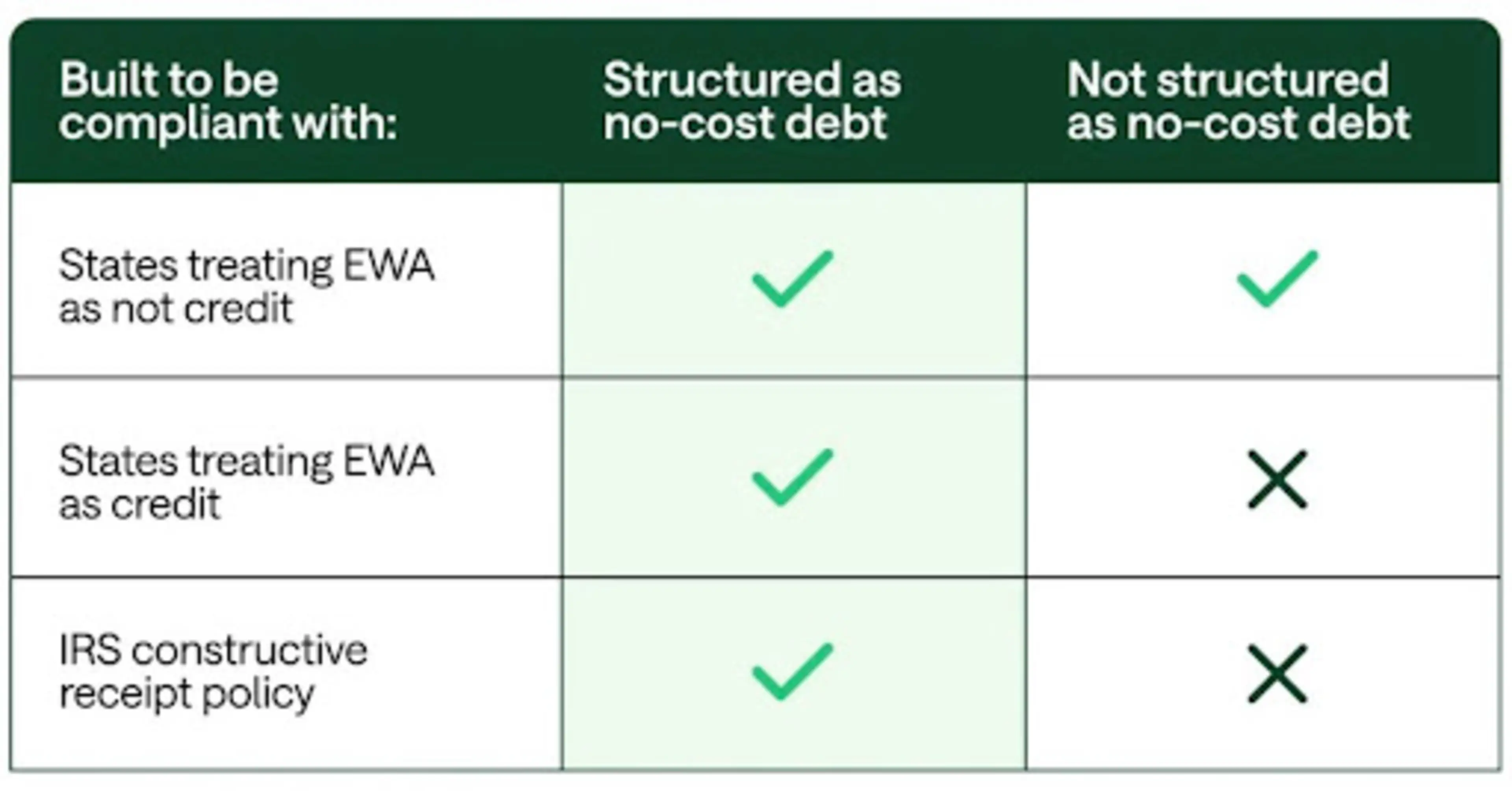
California, Connecticut, and Maryland passed laws and regulations treating EWA as credit in their states. Together, these states represent 15% of the U.S. population.
Nine other states have passed laws specifically stating that EWA is not subject to state lending laws. (see disclosure 12) Collectively, these states represent 12% of the U.S. population.
That leaves 38 states, representing 73% of the U.S. population, that have yet to pass laws or regulations addressing this question at the state level.
In 2025, the Consumer Financial Protection Bureau issued an advisory opinion clarifying how certain earned wage access (EWA) is not credit under the Truth in Lending Act and Regulation Z. The Bureau determined that employer-offered EWA settled through payroll processes is not considered credit under federal law when it meets specific structural criteria. This federal clarity helps employers better understand the regulatory treatment of EWA, while state wage, labor, and lending laws continue to apply.
The Treasury Department has flagged in its Green Book that when earned wage access is not structured as a loan, it risks being treated as a wage payment under the constructive receipt doctrine, meaning the accessed amount could be deemed paid, and taxable, at the moment of access. The reasoning is binary: money delivered through EWA was either borrowed by the worker or already owned by the worker, and if it was already owned, its delivery is a wage payment.
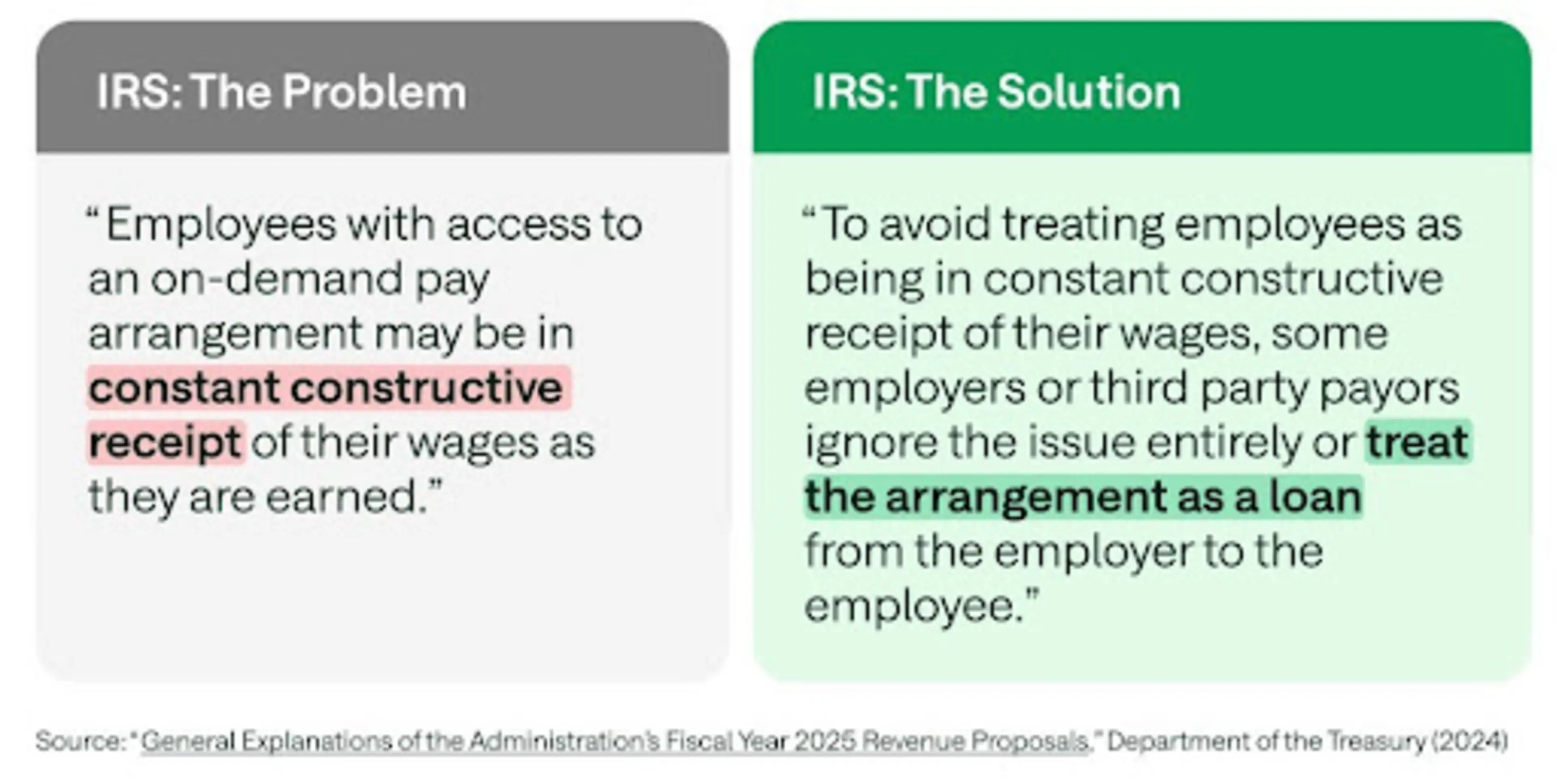
That is why the one structure that operates cleanly across credit-treatment states, non-credit states, CFPB policy, and tax policy is EWA structured as no-cost debt, with repayment settled in the employee's bank account rather than through payroll.
The History of Earned Wage Access: 2015 to Today
Employer-offered earned wage access turned ten in 2025. The decade in brief:
• 2015. Jason Lee and Rob Law pioneer earned wage access for employers. Lyft becomes the first major company to offer instant access to pay; DailyPay, Branch, and Instant are founded, joining Payactiv, Even, and FlexWage as the first third-party providers.
• 2016. Uber drivers gain access to their pay, first through DailyPay and then Uber's own Instant Pay, as the gig economy normalizes instant payouts.
• 2017. Walmart partners with Payactiv and Even to offer EWA to its 1.4 million associates; within two years, half a million have used it.
• 2018. Providers begin distributing through HCM storefronts such as the ADP Marketplace.
• 2019. A wave of new fintech entrants and major funding floods the market.
• 2020. The COVID-19 pandemic drives mainstream adoption; HCM and payments companies including Ceridian and Square launch their own EWA products.
• 2021. The number of EWA companies reaches 55.
• 2022. Industry volume reaches $22 billion: per the CFPB's Data Spotlight, roughly 7 million employees access those funds at an average fee of $3.18 per transaction. (see disclosure 13)
• 2023. California publishes its analysis of 2021 EWA data, reporting a 331% average APR for non-tip providers, as states begin to diverge on regulation. (see disclosure 14)
• 2024. The CFPB proposes an interpretive rule treating most paycheck advance products as loans; Chime launches no-fee earned wage access.
• 2025. The New York Attorney General sues an EWA provider, citing high fees and payroll repayment. In December, the CFPB's advisory opinion concludes Covered EWA is not credit and withdraws the 2024 proposal.
• 2026. Everest Group publishes research showing evolution of EWA from fee-for-advance app to free financial wellness platform.
Ten years in, the arc is clear. The first generation delivered access and flexibility. The modern era asks more: completely free for workers, built for compliance across all 50 states with providers repaid outside of payroll, and delivered as part of a financial wellness platform that helps workers build savings, track spending, and improve their credit.
Earned Wage Access Apps and Platforms
For employees, earned wage access lives in an app. A typical EWA app shows the available earned balance updated daily or in real time, lets the worker choose an amount and a delivery speed, and displays what was accessed so payday holds no surprises. The distinction that matters for employers is between an EWA app and a financial wellness platform. An app answers one question: how do I get my earned pay today? A platform treats wage access as an entry point and surrounds it with the tools that address why the employee needed early access in the first place: lack of savings.This explains why 91% of financial app users prefer a platform to meet all of their needs, rather than multiple point solutions. (see disclosure 15)
The most robust platforms offer automated savings, credit building, spending insight, financial education, and more. The difference shows up in the goal each is built toward. The best EWA program is the one users rely on less over time because they have graduated to savings, and only a platform that can see and support the user's broader financial picture can measure or produce that outcome. In Everest Group research commissioned by Chime Enterprise, 77% of enterprises cited financial wellness, not wage access alone, as the primary driver of EWA adoption, and 56% said they now require a no-fee EWA model, a shift visible in zero-fee EWA employer adoption. (see disclosure 11)
On the employer side, platform capability means administrative tooling: eligibility syncing by role, status, and location, program dashboards, utilization reporting, and disclosure support for state registration regimes.
Explore product details of a settlement-based, no-fee implementation in an Earned Wage Access platform.
Earned Wage Access Integrations with Payroll and HCM Systems
Integration is the part of earned wage access buyers see least and depend on most. The entire compliant structure of EWA rests on verified earnings: the CFPB's Covered EWA framework presumes the provider knows, from payroll data, what the worker has actually accrued. Wage verification, not credit evaluation, is the foundation of EWA.
In practice, providers connect to payroll, HCM and time-and-attendance systems such as Workday, UKG, and ADP through two mechanisms: secure APIs that sync wage accruals in real time or daily, and file-based integrations that exchange scheduled data extracts. The integration typically carries three data flows: wage and hours accrual for balance calculation, employee eligibility attributes such as role, employment status, and work location, and payroll results data that reconciles each pay period’s balance against what was actually paid. In settlement-based programs, the integration may also write employee-authorized direct deposit elections back to the payroll system, so wages route to the account where settlement occurs.
Integration architecture also shapes the employee experience. Real-time accrual syncing means a worker who finishes a shift sees the balance move the same day. And it shapes the payroll team's experience: settlement-based programs that recover funds outside payroll leave the payroll run untouched, while deduction-based programs make every access request a payroll event that has to be reconciled cleanly against hours, corrections, and garnishment ordering. The current federal framework also carries specific implications for payroll professionals in how these processes are documented and run.
Earned Wage Access by Industry
Adoption of earned wage access concentrates in industries with large hourly workforces, variable schedules, and elevated turnover. Federal labor data explains why. In the Bureau of Labor Statistics' Job Openings and Labor Turnover Survey, the national quits rate has run near 2% of employment per month through 2025 and into 2026, with hourly-heavy sectors consistently posting the largest movements. (see disclosure 16) And the findings by the Employee Benefit Research Institute makes the use case concrete: the most common use case for EWA was food. (see disclosure 17)
Retail
Large part-time workforces, seasonal staffing swings, and scheduling variability create frequent income timing gaps. Retail is also where EWA first proved out at enterprise scale, with Walmart's 2017 rollout demonstrating adoption across a workforce of over a million associates.
Hospitality and Food Service
Tipped and shift-based pay makes weekly income volatile even when hours are steady, and the sector's persistently high voluntary turnover makes retention economics the central argument for EWA. A predictable earned-wage balance smooths the gap between variable tip income and fixed expenses.
Healthcare
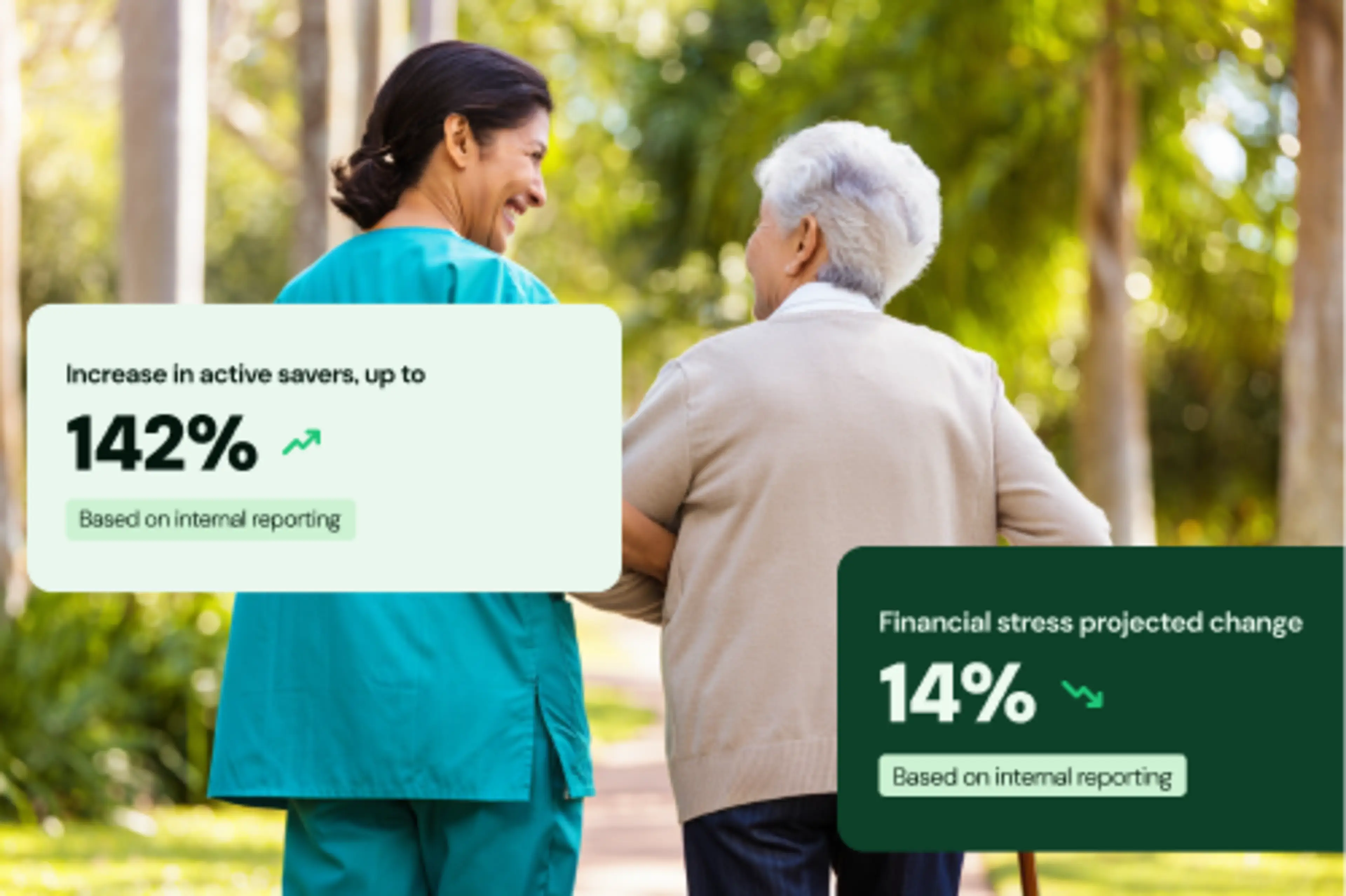
Hospitals, senior living, and home care combine around-the-clock shift work, differential pay, and chronic staffing shortages, making EWA both a recruiting differentiator and a retention lever for aides, nursing assistants, and support staff. The sector also has some of the category's most concrete outcome data: in one senior living case study, a roughly 3,500-employee operator that replaced its legacy EWA program projected up to $742,000 in annual employee fees avoided, observed a 12.5% reduction in an internal financial stress metric within a few months, and reported a 145% increase in savings accounts opened, based on internal data and early program observations. (see disclosure 18)
Transportation, Logistics & Manufacturing
Hourly pay plus overtime variability means take-home pay can swing meaningfully between checks, and plant or warehouse slowdowns compress hours without warning. Earned wage access buffers those swings without any change to the payroll calendar.
Government and Public Sector
Public employers run some of the country's largest hourly and shift-based workforces, from transit and sanitation to corrections and emergency dispatch, on famously rigid pay calendars. As agencies compete with private hourly employers for the same workers, earned wage access has begun appearing in public-sector benefits conversations as a no-budget-impact differentiator.
Call Centers and Customer Support
Call centers combine hourly pay, strict schedule adherence, and some of the highest attrition rates of any office-based work. Because financial stress is a documented driver of both absenteeism and early exits, EWA functions there as an attendance and retention lever as much as a financial benefit. The sector has outcome data of its own: in one call center case study, Incept, a call center support company that built its financial well-being strategy around tools including earned wage access, reported 78% employee enrollment, a 61% improvement in turnover, and 60% of employees setting long-term financial goals. (see disclosure 19)
Across all of these sectors, employer adoption still has substantial headroom. A 2024 report from the International Foundation of Employee Benefit Plans, cited by CNBC, found earned wage access offered by only 2.5% of corporate employers, even as the list of adopters includes Walmart, Amazon, Target, and McDonald's. (see disclosure 20) What holds the rest back is rarely the concept and usually the implementation questions, the pattern behind most EWA adoption barriers. For HR and payroll leaders in hourly-heavy industries, the practical takeaway is that earned wage access has federal regulatory clarity, a maturing state framework, proven enterprise-scale implementations, and a workforce whose pay expectations have already shifted. The question is no longer whether the category is legitimate, but which model to bring in.
Sources
Consumer Financial Protection Bureau, "Data Spotlight: Developments in the Paycheck Advance Market"
CNBC, "More workers get early access to pay, critics see unregulated lending" (February 2026)
Federal Reserve Board, Survey of Household Economics and Decisionmaking (SHED)
U.S. Bureau of Labor Statistics, Job Openings and Labor Turnover Survey