
As employers expand earned wage access (EWA) and financial wellness programs, one question consistently surfaces: How do we reduce financial stress without creating long-term dependency or administrative burden? The answer may be simpler, and more measurable, than you think.
The most reliable indicator of employee financial wellness is whether employees are actually saving. Not accessing benefits. Not enrolling. Saving. That is why the employee savings account has emerged as an important KPI in modern financial wellness strategies.
What Is an Employee Savings Account (ESA)?
An employee savings account (often referred to as a workplace emergency savings account) is a savings vehicle designed to help employees build a dedicated cash buffer for unexpected expenses. ESAs are sometimes embedded in a financial wellness platform, making saving easier and more consistent.
The goal of an employee savings account is not just to cover emergencies—it is to help employees move out of paycheck-to-paycheck cycles and toward financial stability over time.
For employers, ESAs are powerful because they:
Reduce financial stress before crises occur
Decrease reliance on high-cost credit and repeated borrowing
Improve 401(k) participation and reduce hardship withdrawals and loans
Support productivity, attendance, and retention
Research shows that even modest savings—$2,000 or two to four weeks of expenses—has a greater positive impact on financial well-being than paying off unsecured debt or increasing income, especially for workers earning under $50,000.1
The most reliable indicator of employee financial wellness is whether employees are saving.
Types of Employee Savings Accounts
When it comes to offering workplace savings accounts, employers typically have three options:
Pension-linked emergency savings accounts
Out-of-plan emergency savings accounts
Earned wage access (EWA) savings accounts
These accounts can differ greatly in employer cost, employee access, and breadth of financial wellness tools.
Pension-Linked Emergency Savings Account (“PLESA”)
Pension-linked (aka in-plan) emergency savings accounts were introduced as part of the SECURE Act 2.0, which Congress passed in 2022. These PLESAs are intended to reduce the 401(k) leakage that occurs when a worker takes a 401(k) loan or hardship withdrawal to fund an emergency expense. When employees make early 401(k) withdrawals, there can be costly penalties and taxes. Plus they miss out on the compounding returns of their retirement funds.
The biggest drawback of PLESAs is that they can only be used by workers enrolled in a 401(k) program. This often excludes the employees most in need of savings who cannot afford the cost of 401(k) contributions. PLESAs are structured as 401(k) sidecars and are subject to many of the ERISA rules governing defined contribution plans. Contributions are capped at $2,600 per year. There is a limit of four free withdrawals per year and highly compensated individuals are not eligible to participate. Unlike a traditional 401(k), employee contributions are after-tax.
PLESAs typically come with employer matches. For companies experiencing pressure on their benefits budgets, the cost can be an issue. Employers have the option of including automatic enrollment in their PLESA program.
Out-of-plan Emergency Savings Account
As the name suggests, an out-of-plan emergency savings account is not linked to a 401(k). Thus, employees can participate whether or not they are enrolled in a defined contribution plan. These accounts are not subject to ERISA rules and also not typically subject to contribution, withdrawal, or income limits.
Like PLESAs, out-of-plan accounts often involve an employer matching contribution. This can be a constraint for companies experiencing pressure on benefits budgets. Unlike PLESAs, automatic enrollment is not available. Also, out-of-plan accounts may not be actual bank accounts, limiting their ability to offer attractive interest and enable instant withdrawals. For example, a worker often has to link a bank account and request an ACH withdrawal to access funds. This can take one to three business days, which is not ideal for emergency situations.
Earned Wage Access (EWA) Savings Account
Earned wage access allows employees to access wages they have already earned, before payday. It is highly effective for short-term cash-flow timing issues, such as avoiding overdrafts, paying bills, and dealing with unexpected emergency costs. Nearly four out of ten Americans can’t afford a $400 emergency expense and two-thirds are living paycheck-to-paycheck.2,3
First-generation EWA apps were typically point solutions, meaning they offered little to no other tools like savings or credit building. That has changed.
Everest Group, a leading research analyst, issued a 2026 study detailing the evolution of EWA from a liquidity perk to a core feature of a financial wellness platform. These modern platforms can offer fully integrated savings accounts with high interest rates, automated tools, and personalized goals. As workers build their savings habits, they may rely on EWA less and less. Seventy-seven percent of employers rolling out EWA are doing it for financial wellness, and these new savings accounts play a key role.4
77% of employers rolling out EWA are doing it for financial wellness.
Why Savings Is the Most Important Feature of Employee Financial Wellness
Workers experience the largest boost in financial health when they start saving. In a study of over 12,000 workers, Vanguard found that saving $2,000 yields the greatest improvement in one’s financial well-being score.1 The boost is more than four times as powerful as increasing one’s income from around $50,000 to around $100,000.
How can saving a couple of thousand dollars have a bigger impact than a doubling of income? Because life is incredibly stressful for workers without savings. They may be constantly worried about running out of money, paying the rent, being able to afford groceries, or staving off debt collectors. Once they start saving, that stress subsides and they experience an enormous boost in financial well-being.
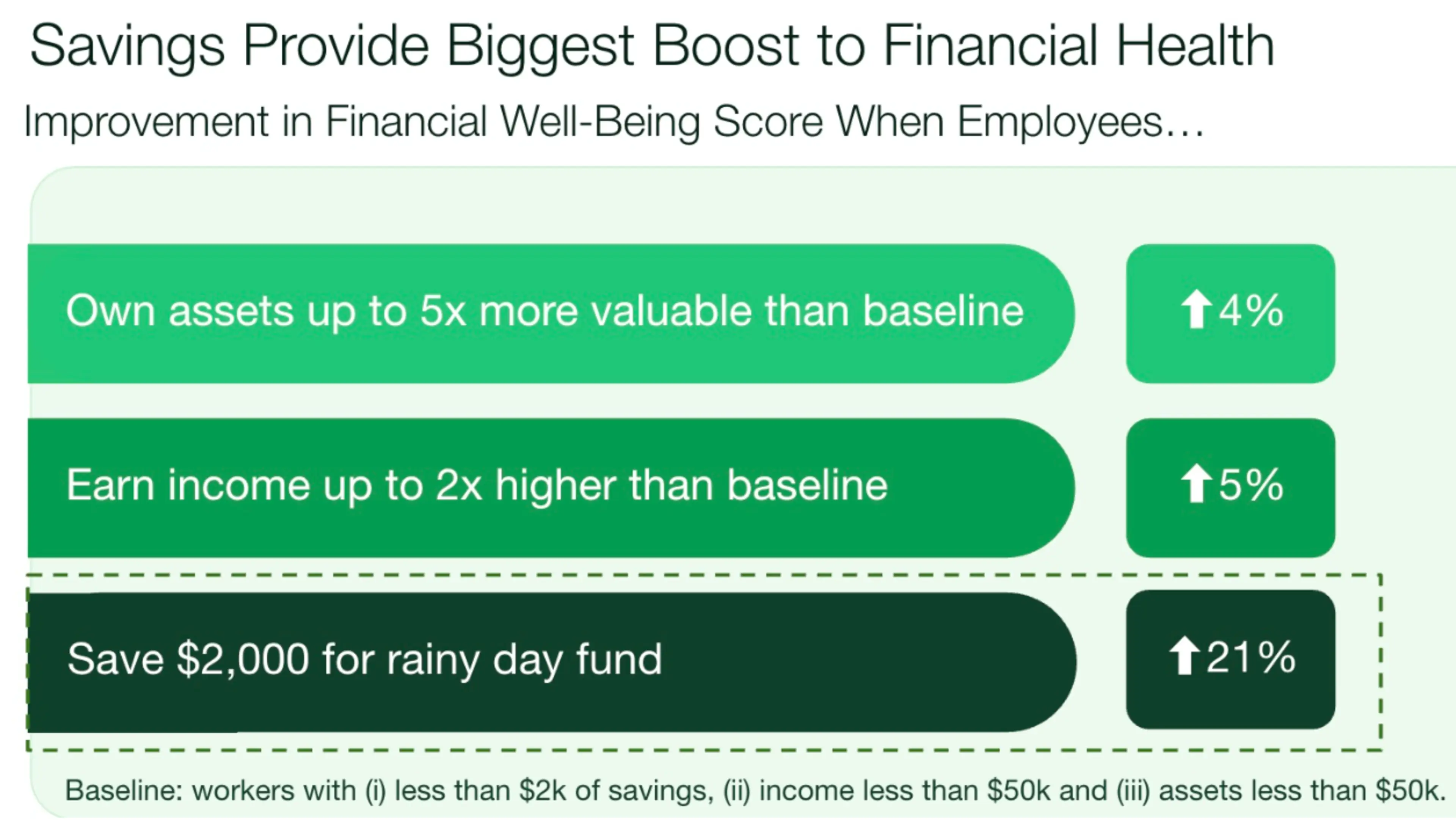
Source: Vanguard Research (2025)
When employees start saving, their retirement account participation rises from 29% to 71%.5 They are half as likely to take out a 401(k) loan and one-eighth as likely to take a hardship withdrawal.6 Saving is a path to investing and planning for the future.
Why Savings Is a KPI for Employee Productivity
Workers also perform better at work when they have a rainy day fund. The National Bureau of Economic Research found that workers with emergency savings are focused four more hours per week.7 They are no longer constantly distracted by money problems at work. With reduced financial stress, their rate of absenteeism and tardiness improves by 25%.8 Their rate of turnover drops by 28% and the employee satisfaction rises by 10%.9
Comparing Employee Savings Account Models
Not all ESAs are created equally. The structure of the employee savings account determines whether it actually changes behavior or becomes another underused benefit. Below is a comparison of the primary models available to employees today.
Employee Savings Account Comparison
Pension-Linked Emergency Savings Account | Out-of-Plan Emergency Savings Account | Chime Workplace Savings Account | |
All workers eligible | No | Yes | Yes |
Instant access | No | No | Yes |
High yield | Sometimes | Sometimes | Yes |
No cost to employer | No | No | Yes13 |
Free withdrawals | Limited | Yes | Yes |
Other banking tools | No | No | Yes |
Earned wage access | No | No | Yes |
This comparison highlights a critical insight for employers: Most traditional ESAs involve tradeoffs—lower yield, employer cost, lack of instant access, or siloed user experiences that limit long-term engagement.
Why an Employee Savings Account Is a Must-Have Benefit
If the goal of a financial wellness program is measurable improvement, not just benefit availability, then an employee savings account must be foundational. Here is why.
ESAs are proactive, not reactive.
Relief funds and borrowing solutions respond after financial stress escalates. ESAs reduce the frequency of emergencies by preparing employees in advance.
ESAs preserve dignity and speed.
Employees access their own savings instantly, without approval processes or definitions of what qualifies as an “emergency.”
ESAs reduce dependency on borrowing.
When savings is available, employees rely less on high-interest credit, repeated EWA usage, and app-based borrowing cycles that do not improve long-term financial health.
ESAs support productivity and retention.
As broken down earlier, financial stress leads directly to absenteeism, disengagement, and turnover. Employees with savings buffers are more focused, resilient, and stable at work.7,8
ESAs are the clearest financial wellness KPI.
Savings participation rates and average balances tell employers whether their financial wellness strategy is working. Utilization metrics alone do not.
Why ESAs via Chime Workplace Are Structurally Different
Many employee savings accounts struggle because they are isolated—separate portals, limited features, and friction-heavy experiences that employees abandon over time.
ESAs delivered through Chime WorkplaceTM take a different approach. Instead of treating savings as a standalone benefit, Chime Workplace embeds the employee savings account10 directly into a single financial ecosystem where employees already manage their money. High-yield savings, no minimum balance requirements, everyday banking tools, automation12, and portability are combined into one experience—at no cost to the employer13.
This structure matters because behavior change happens through design, not education alone. When saving is automatic, visible, and integrated, participation and balances grow naturally.
For employers evaluating EWA and financial wellness programs, the key takeaways are clear:
EWA helps employees manage timing gaps.
ESAs help employees reduce how often those gaps occur.
Chime Workplace integrates EWA and ESAs so employees can build savings, in order to help them to break free from the paycheck-to-paycheck cycle.
The Bottom Line for Employers
An employee savings account is no longer a “nice to have” within financial wellness programs. It is one the most direct, measurable ways to help reduce financial stress, protect productivity, and support long-term workforce stability.
As financial wellness as a workforce benefit matures, employers should focus less on how many benefits are offered and more on what outcomes those benefits produce. If employees are not saving, financial wellness is not working.
That is why the employee savings account—specifically one designed to remove friction, cost, and complexity—should sit at the center of every modern financial wellness strategy.
Help Your Employees Make Progress
Chime Workplace is built around the standard that enrollment and utilization metrics alone don't tell you much, but savings balances do. Its employee savings account is embedded in a comprehensive, one-portal financial wellness platform, at no employer cost. Request a demo now.
Sources & Disclosures
1 “The relationship between emergency savings, financial well-being, and financial stress,” Vanguard research (2025).
2 “The Report on the Economic Well-Being of American Households,” Federal Reserve (2026).
3 “Tax Refunds and the Paycheck-to-Paycheck Consumer,” PYMNTS (2026).
4 “The Reinvention of Earned Wage Access,” Everest Group (2026).
5 “Emergency Savings and Financial Security Report,” CFPB (2022)
6 Emergency Savings Linked to Less 401(k) Loan Use, Stronger Retirement Outcomes,” Plan Advisor. (2025)
7 “The Economics of Financial Stress,” NBER (2023)
8 “Financial Stress and Mental Health Findings,” TIAA Institute (2024)
9 “Does Saving for Emergencies Improve Productivity at Work?,” AARP Public Policy Institute (2024)
10 Chime Checking Account is required to be eligible for a Savings Account.
11 The Annual Percentage Yield ("APY") rates are variable and can change at any time. See here for current Chime APY rates. National APY rates reported by FDIC here.
12 Round Ups automatically round up debit card and credit card purchases to the nearest dollar and transfers the round up into your savings account. You can also automatically transfer part of your direct deposits of $1 or more from your Checking Account into your selected Chime account(s).
13 Certain optional fees apply to services. See Chime.com/policies for more information.