
Back in January, we laid out where we thought payroll was heading in 2026: Payroll-friendly earned wage access going mainstream, payroll and banking finally merging, artificial intelligence reshaping the payroll desk, and the function itself climbing toward the C-suite. Predictions are easy to make in January and easy to forget by summer. So we went looking for a scorecard.
With the goal of measuring our hunches against how the landscape is actually unfolding, Chime WorkplaceTM partnered with PayrollOrg®, the leading professional association for payroll, on a survey of 831 payroll professionals fielded in April 2026, spanning artificial intelligence, banking, and earned wage access. Respondents include practitioners and decision-makers across a wide range of industries and organization sizes. The results are the ultimate reality check—the payroll community's own answers on how our calls are tracking.
Fee-Free, Compliant Earned Wage Access Becomes the Standard
What we said: First-generation earned wage access apps, built on payroll deductions and instant-access fees, would give way to models that are fee-free, built for compliance, and embedded in a financial wellness platform.
How it's going: Payroll pros are treating fees as a liability, not a negligible factor. In a previous survey, 91% of payroll professionals said EWA should be free, while two-thirds viewed EWA fees as an outright compliance risk.1
That wariness has real-world backing: A 2025 lawsuit by the New York Attorney General found that workers using one leading EWA app were paying an average of $370 a year in fees, with one worker taking 450 advances over two years and paying more than $1,4002. Signals are clearly pointing away from the fee-based models we flagged in January.
EWA Structure Assessed to Sidestep Constructive Receipt Risk
What we said: Compliance concerns would push employers toward EWA models designed to reduce payroll risk.
How it's going: Tax structure turned out to be the deciding factor. Nearly two-thirds of payroll professionals said they favor EWA structured as a no-cost debt to avoid constructive receipt risk—the question of whether simply having access to earned wages could trigger tax withholding3.
The U.S. Department of the Treasury has suggested EWA can be structured as credit to avoid this risk, in its General Explanations of the Administration's Fiscal Year 2025 Revenue Proposals (2024). To be clear, the IRS has not enforced constructive receipt on non-credit EWA programs; payroll's preference reflects a desire to get ahead of the risk rather than a response to enforcement.
The repayment mechanics matter for the same reason. As Christopher Wood, CPP, of Thomson Reuters Checkpoint has noted, the deduction and payroll-intercept models used by traditional providers can carry risk in states with wage-assignment or improper-wage-deduction statutes. Moving repayment to bank-account settlement, outside of payroll, removes that administrative burden.
“Payroll Friendly” EWA Goes Mainstream
What we said: We posited that payroll-friendly on demand pay, reflective of the first two developments above, would become an industry standard in 2026, especially for frontline and hourly workforces.
How it's going: Per the current survey, 19% of payroll practitioners already offer EWA as part of the pay experience, and another 17% are considering rolling it out, which would nearly double the share of payroll departments offering it.3 That trajectory lines up with research from the Everest Group, which projects that adoption will accelerate as fee-free, compliance-built financial wellness platforms arrive.
Payroll and Banking Integrate
What we said: The invisible wall between payroll and banking would start to fall, with workplace banking giving payroll real-time visibility and, to workers, financial tools embedded in the pay experience.
How it's going: Payroll pros see the same convergence taking place that we did. Three out of four survey respondents expect the trend to continue, and 85% see clear value in payroll and banking coming together for both the department and employees.3
The most-cited benefits were direct-deposit tracking and faster resolution of employee pay inquiries through real-time insights. The latter is a meaningful pain point, given that more than half of payroll pros report spending at least three hours a month on pay inquiries, and 14% spend ten hours or more.3
Payroll Roles Shift Toward Analysis as AI Arrives
What we said: As routine data entry became automatable, payroll talent would shift from data entry toward data analysis.
How it's going: Payroll pros are deliberately drawing the line as far as AI’s place in their day-to-day. Asked where AI fits, they put data entry and error reduction at the top, followed by compliance tracking and forecasting; while only about one in three expect to use AI for an employee-facing function like onboarding.3
Respondents’ top apprehension was data security and privacy, and that caution proved well-timed: In July 2026 (after the survey closed), a first-of-its-kind AI-versus-AI cyberattack succeeded in a way that surprised some AI leaders. Three out of four payroll pros had already flagged this category of risk.3
The upshot: As predicted, payroll is willingly delegating automated tasks, in favor of prioritizing the critical-thinking parts of the job.
Payroll Climbs Toward the C-Suite
What we said: Payroll would increasingly be seen as a strategic enabler, with the 30x30 communityTM pushing the conversation toward a Chief Payroll Officer seat at the leadership table.
How it's going: Industry analysts are starting to back payroll’s ascent to a more strategic role. In March, KPMG authored a landmark report that called for payroll in the C-suite. And the community side is building, too. More than 1,500 payroll professionals have joined the 30x30 community, which offers members free career resources, event opportunities, and networking.
The survey's broader through-line reinforces the premise: Payroll pros are evaluating AI, banking, and EWA through the lens of compliance and strategic value, not just administration. This is the kind of shift in posture that a more elevated payroll role depends on.
The Scorecard, Nine Months In
Forecasting is tough, and there's more of 2026 left to play out. But the pattern across payroll professionals is consistent with the calls we made in January:
Fees are increasingly read as compliance risk.
Structure and repayment mechanics are driving EWA decisions.
Adoption has real runway.
Payroll and banking are converging in the eyes of the people who run both.
AI is being adopted with intent rather than abandon.
The crystal ball, it turns out, is holding up reasonably well. 🔮
Read the full results
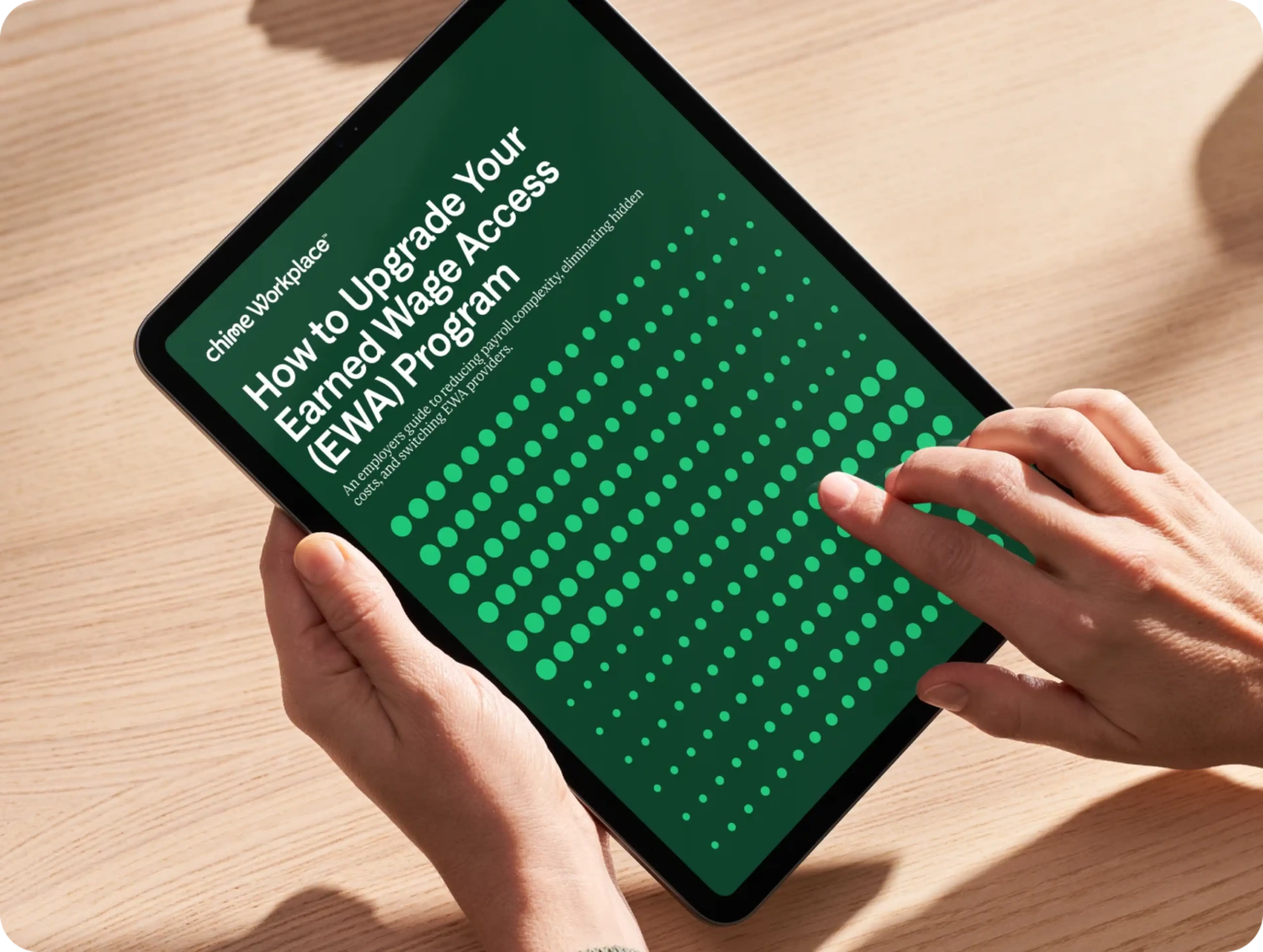
For more depth on what payroll pros told us in the Chime Workplace and PayrollOrg survey, get the full reports:
Want to see what payroll-friendly technology looks like in practice, i.e. modern, low-lift EWA and real-time pay visibility built for compliance? Schedule a call with a Chime Workplace expert.
Sources & Disclosures
1 “Payroll pros prefer fee-free and compliance-conscious Earned Wage Access,” Chime Workplace (2026)
2 NY Attorney General, State of New York v. DailyPay, Verified Petition (2025)
3 PayrollOrg survey of 831 payroll professionals (2026)
Survey data: PayrollOrg and Chime Workplace, survey of 831 payroll professionals, fielded April 2026. PayrollOrg led distribution and data collection; Chime Workplace partnered on survey design and analysis.
2026 Payroll Predictions (Chime Workplace, January 2026)
On-Demand Pay, Off-Schedule Compliance — Thomson Reuters Checkpoint (May 2026)
Chime Workplace listing — Workday Marketplace (NY AG fee figures)
AI-versus-AI cyberattack coverage — CNBC (July 2026)
Certain optional fees apply to services. See Chime.com/policies for more information.
The statistics in this content are based on third-party research and industry studies; results may vary by employer and workforce.