Employee productivity is one of the most talked-about topics in business but one of the least understood. Conversations often focus on time management, deadlines, or output metrics. But the employers getting the most from their teams understand productivity is not just about how employees work but conditions surrounding that work. And many of those conditions quietly make it harder for people to show up at their best.
In 2026, the most effective organizations no longer measure productivity solely by hours worked. They are measuring it by clarity, focus, alignment, and the ability to execute without unnecessary friction. And they are investing in programs and tools that address both the structural side of work — workflows, scheduling, documentation, and communication — and the human side, including the financial, physical, and emotional factors that shape how much people can realistically bring to their roles each day.
This article explores what employee productivity really means, the many factors that shape it, how proactive employers are addressing it, and the tools making a measurable difference in 2026.
What Is Employee Productivity?
Employee productivity refers to the value an employee generates relative to the time, energy, and resources they invest. In practical terms, it shows up as tasks completed, ideas generated, problems solved, and products and services delivered. Productivity fluctuates based on many variables, some of which have nothing to do with effort or attitude. An employee who is struggling financially, sleeping poorly, buried in an overflowing inbox, dealing with a family caregiving crisis, or searching three different platforms for a document they need right now may be trying just as hard as they ever have. They are simply working with fewer resources available to them.
12 Factors That Impact Employee Productivity
Productivity is shaped by a wide range of factors spanning the physical, emotional, financial, and organizational dimensions of an employee's life.
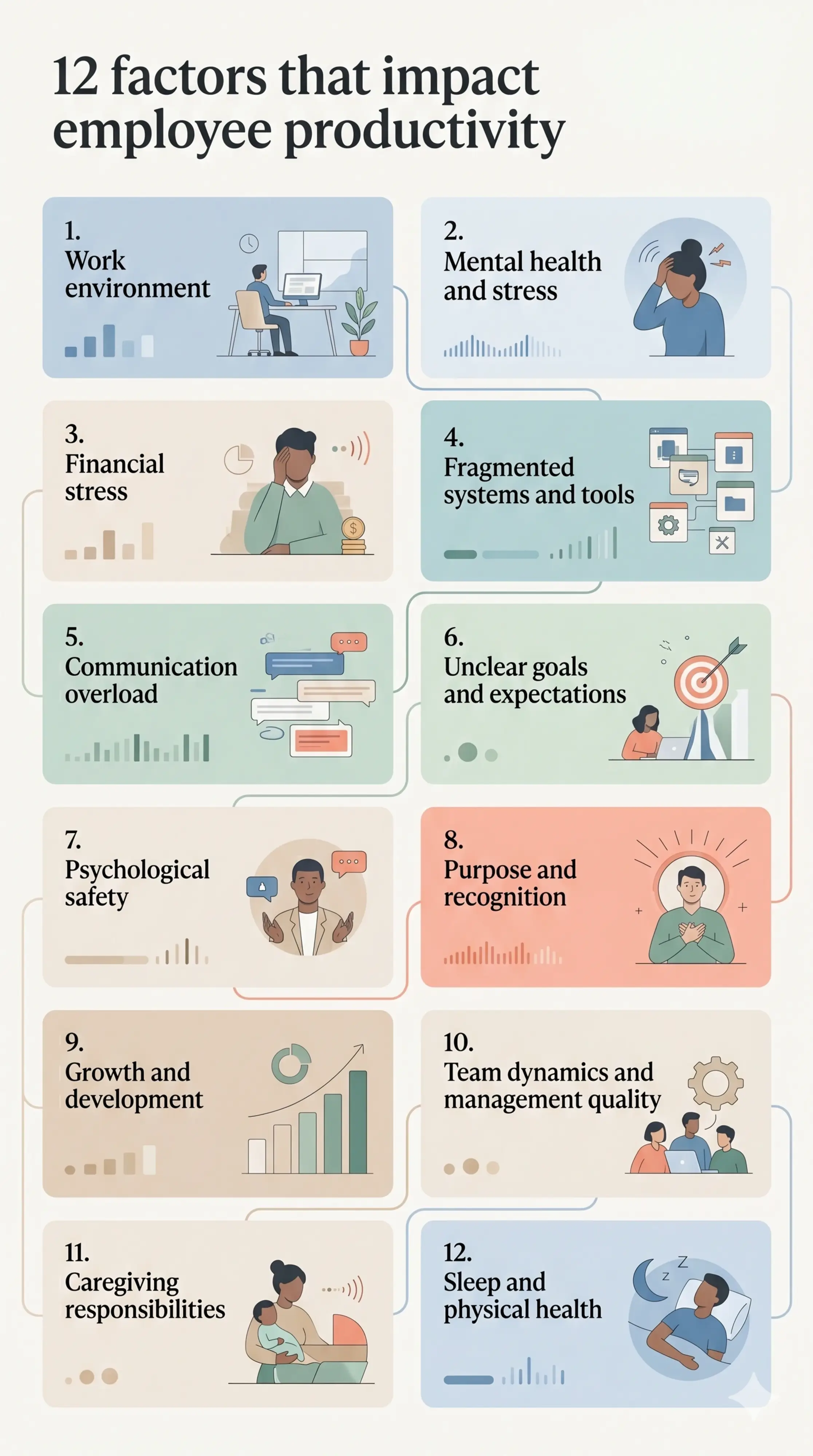
Work environment. The physical conditions in which people work have a direct effect on concentration, energy, and sustained focus throughout the day.
Mental health and stress. Anxiety, burnout, and chronic stress are among the leading causes of both presenteeism (being physically present but mentally checked out) and absenteeism.1 Employees who are overwhelmed have reduced capacity for complex thinking, communication, and problem-solving.
Financial stress. Personal financial worries are one of the most common and least addressed sources of employee distraction. Workers spend 6.4 hours on average during the work week distracted by money problems, according to an NBER study.2
Fragmented systems and tools. When workflows are disconnected, documentation is scattered across platforms and employees spend significant time searching for information or re-entering data across systems. The result is a constant low-grade drain on time and attention.
Communication overload. Email overload, excessive meetings, and fragmented messaging channels reduce the time available for deep, focused work. Employees who are constantly interrupted lose the capacity for the kind of sustained thinking that produces the most valuable output.
Unclear goals and expectations. Employees perform better when they understand what success looks like and how their work connects to broader organizational priorities. Ambiguity around goals creates wasted effort, misaligned work, and disengagement over time.
Psychological safety. Employees who fear judgment or retaliation tend to hold back ideas, avoid taking ownership, and disengage from collaboration. A culture where people feel safe to speak up, make mistakes, and ask questions consistently outperforms one where they do not.
Purpose and recognition. Employees who feel their work matters and are recognized for their contributions bring more energy and commitment to their roles. The absence of recognition drains motivation in ways that are hard to measure but easy to feel.
Growth and development. People who feel stuck or overlooked for development opportunities disengage progressively. Stagnation is one of the quieter drivers of turnover and declining performance.
Team dynamics and management quality. Interpersonal conflict, unclear expectations, and inconsistent feedback are consistently among the biggest contributors to disengagement. Research shows that the quality of a person's direct manager is the single greatest variable in their day-to-day experience at work.
Caregiving responsibilities. More than half3 of the workforce is managing some form of caregiving responsibility — for children, aging parents, or family members with health challenges. These responsibilities create unpredictable demands on time, attention, and emotional energy that rarely show up in official data but are a constant presence in employees' daily lives.
Sleep and physical health. Chronically under-rested employees show measurably lower decision quality, slower processing speed, and higher error rates. Physical health — including nutrition — similarly affects the energy and cognitive clarity that sustained productivity requires.
How Employers Proactively Improve Employee Productivity
The most effective organizations do not wait for productivity problems to surface in performance reviews or exit interviews. They build proactive systems for identifying friction, researching solutions, and continuously improving the conditions their people work in.
This starts with listening. Employers who run regular pulse surveys, maintain open feedback channels, and encourage honest conversations between managers and employees tend to catch emerging issues before they become systemic. They look across multiple data sources: engagement scores, absenteeism rates, benefit utilization, and direct employee input to build a complete picture of where people are struggling.
From there, leading HR and People teams treat vendor research and solution evaluation as an ongoing discipline, not a one-time event. The best benefits and productivity stacks are not assembled once and left alone but are regularly audited for relevance, utilization, and impact.
The most effective employers look at both the structural and human side of productivity. The structural level includes workflows, scheduling, documentation, and communication systems that either make work easy to execute or create constant friction. The human level encompasses the financial, physical, and emotional conditions that shape employee engagement. The programs and tools that follow address both.
Innovative Tools and Programs That Improve Employee Productivity in 2026
The following list combines solutions that streamline how work gets done with solutions that address the less visible but equally important human factors behind it.
1. Workflow Automation and Custom Productivity Systems
When repetitive, manual work consumes employee time, the cost is not just efficiency but also the attention and cognitive energy that could be directed toward higher-value thinking. Custom workflow platforms address this by allowing organizations to design processes around how teams actually work, rather than forcing teams to adapt to rigid, off-the-shelf systems.
Platforms like Quickbase® enable employers to build low-code applications that centralize workflows, automate repetitive tasks, and create visibility across departments. Instead of relying on disconnected spreadsheets, email chains, and manual handoffs, teams operate within structured systems that reduce delays and errors. When repetitive work is automated, employees regain time for the work that genuinely requires their judgment and expertise.
2. Employee Financial Wellness Platforms
Financial stress is one of the most pervasive and least visible drains on employee productivity. Employees dealing with debt, an unexpected bill, insufficient savings, or ongoing financial uncertainty do not leave those worries at the door when they arrive at work. Workers without emergency savings spend approximately 8.2 hours1 every week in the workplace distracted by money problems
Employee financial wellness platforms like Chime Workplace™ address this directly. Solutions in this space typically offer employees access to personalized financial coaching, budgeting support, credit building, emergency savings programs, and financial education — delivered through a single platform, sometimes at no cost. What makes these platforms particularly effective is that they meet employees at the point of actual need. For employers, the return is tangible. Employees who feel financially secure are more focused, more engaged5, and less likely to quit6.
3. Knowledge Management and Documentation Hubs
One of the most persistent and under-appreciated drains on employee productivity is time spent looking for information. Employees spend a significant portion of their workday searching for documents, policies, previous decisions, or process guidance that should be immediately accessible but is not.
Centralized knowledge management platforms like Notion® give organizations a single, structured hub where teams document processes, track projects, and preserve institutional knowledge. When documentation is standardized and genuinely accessible, onboarding accelerates, decision-making improves, and redundant work decreases.
Tools like Guru™ take this further by delivering verified company knowledge directly within employees' existing workflows. Instead of switching platforms or interrupting a colleague, team members can access accurate, up-to-date information exactly when and where they need it. Reduced context switching results in stronger decisions and higher throughput across the organization.
4. Email and Communication Optimization
The average knowledge worker receives dozens to hundreds of emails each day, and the cognitive cost of constantly triaging, responding to, and being interrupted by inbox noise is significant. Each email notification is a small interruption — and as research has shown, even small interruptions have outsized effects on sustained concentration.
Intelligent communication tools like SaneBox™ address this by automatically filtering and prioritizing messages, surfacing what genuinely requires attention and deprioritizing what does not. The result is an inbox that functions as a useful tool rather than a source of constant distraction.
Some employers are also auditing their internal communication culture more broadly — examining meeting frequency, length, and necessity; evaluating whether messaging channels are being used effectively; and building organizational norms that protect employee time for focused, uninterrupted work.
5. Workforce Scheduling and Shift Optimization
For hourly and frontline teams, productivity begins well before the first task of the day. Poorly managed scheduling — with last-minute changes, unclear shift assignments, inconsistent coverage, and chronic understaffing — can create operational disruption and employee frustration.
Scheduling platforms like Shift streamline the entire scheduling process: from availability tracking and shift creation to team coordination and real-time adjustments. When schedules are transparent, fairly distributed, and easy to access, teams operate with fewer disruptions and employees experience significantly less of the logistical stress that frequently undermines their performance.
6. Time Tracking and Productivity Analytics
Data-driven organizations understand that improving productivity requires visibility into where time actually goes. Employers can identify specific bottlenecks, uncover workload imbalances, and make targeted changes that increase output without increasing hours.
Platforms like Hubstaff® and Toggl Track™ provide time tracking and productivity analytics that give organizations the insight they need to make those decisions. Hubstaff offers workforce analytics that surface inefficiencies and resource gaps across remote and hybrid teams. Toggl Track enables project-level time tracking that helps teams analyze how effort is distributed and make more accurate estimates for future work.
The most effective use of these tools is not surveillance or micromanagement — it is system design. When employers understand how time is being spent, they can redesign the workflows, meetings, and processes that are creating the most drag, and redirect that recovered time toward higher-value work.
7. Performance Management and Goal Alignment Programs
Clear goals are one of the most reliable drivers of employee productivity. When employees understand what they are working toward, how their individual work connects to organizational priorities, and what progress looks like, output becomes more focused and intentional.
Integrated performance management platforms such as Leapsome™ combine OKR tracking, continuous feedback, and engagement analytics into a single system. Rather than relying on annual reviews that reflect a moment in time, these platforms create ongoing visibility into whether employees have what they need to succeed and whether their efforts are aligned with what the organization actually values.
Structured goal-setting programs also benefit managers. When expectations are transparent and measurable, managers spend less time clarifying priorities and more time coaching performance and removing obstacles.
8. Sleep Health and Recovery Programs
Here’s a benefit for the most forward-leaning employers. Sleep is rarely addressed in workplace wellness programs, yet its impact on productivity is well-documented in occupational health research. Chronically sleep-deprived employees demonstrate reduced working memory, slower processing, impaired emotional regulation, and lower capacity for creative and complex thinking — all of which directly affect the quality of their work and their interactions with colleagues.
Employer-sponsored sleep health programs are now available through platforms that use clinically validated approaches — including cognitive behavioral therapy for insomnia — along with digital coaching and wearable integrations to help employees identify and address the root causes of poor sleep. Unlike consumer sleep apps, employer-sponsored solutions are typically clinically validated, personalized, and supported by licensed practitioners. For organizations, this benefit delivers meaningful value in a space where almost no other employer is actively investing.
9. Caregiver Support and Family Navigation Platforms
Employees managing childcare logistics, elder care needs or a family member's health condition face a constant stream of complexity that a standard employee assistance program is rarely equipped to address in any practical way.
Caregiver support platforms address this gap by giving employees access to dedicated care advocates who help navigate options, coordinate logistics, find vetted providers, and offer guidance through difficult family decisions. These platforms often include backup childcare access, elder care coordination, parental leave support, and fertility benefit navigation.
The productivity impact is real and measurable. Employees with access to meaningful caregiver support miss fewer unplanned days, experience lower chronic stress, and report significantly higher job satisfaction and organizational loyalty.
10. Nutrition and Energy Management Benefits
The connection between nutrition and cognitive performance is well established, and the World Health Organization has linked adequate nutrition to individual productivity gains. Yet most employer wellness programs do not address nutrition in any meaningful or personalized way.
Employer-sponsored nutrition programs can range from app-based personalized coaching to healthy meal subsidies, dietitian-led group education, and on-site or delivery-based meal programs. The most effective programs connect nutrition explicitly to cognitive performance, energy management, and stress resilience — helping employees understand the direct relationship between what they eat and how clearly, and how sustainably, they can think and work throughout the day.
The Bottom Line
The most effective employee productivity programs in 2026 are not about surveillance, pressure, or working harder. They are about system design and human investment.
Employers that build structured workflows, ensure goal clarity, make knowledge instantly accessible, reduce communication friction, and optimize scheduling create environments where productivity becomes sustainable from the operational side. Employers that address financial stress, sleep, caregiving burdens, and nutrition create environments where employees have the internal resources to bring their best to that work every single day.
The organizations doing both — building better systems and investing in the whole person — are the ones building workforces capable of sustained, exceptional performance. That combination is what defines the next generation of workplace productivity.
Interested in supporting productivity?
Financial stress is a pervasive yet actionable drain on employee productivity. For employers who want to invest in the whole person, Chime Workplace™ gives employees access to holistic financial health tools in one platform. Book a demo to see how a financial wellness layer could be part of your productivity strategy.
1. Univ. of York: The Role of Mental Health on Workplace Productivity
2. NBER, The Economics of Financial Stress
3. Harvard Business Review, Your Employees Are Also Caregivers. Here’s How to Support Them.
4. Univ. of Arizona: The Role of Sleep and the Effects of Sleep Loss on Cognitive, Affective, and Behavioral Processes
5. PwC’s 2026 Employee Financial Wellness Survey
6. SHRM, Employees’ Financial Stress Is Costing Employers Billions
Chime Workplace offered by Chime. Chime is a financial technology company, not a bank. Banking services provided by The Bancorp Bank, N.A. or Stride Bank, N.A., Members FDIC.
The Chime Visa® Debit Card is issued by The Bancorp Bank, N.A. or Stride Bank, N.A. pursuant to a license from Visa U.S.A. Inc. and may be used everywhere Visa debit cards are accepted. The secured Chime Visa® Credit Card is issued by The Bancorp Bank, N.A. or Stride Bank, N.A. pursuant to a license from Visa U.S.A. Inc. and may be used everywhere Visa credit cards are accepted. Please see the back of your Card for its issuing bank.
By clicking on some of the links above, you will leave the Chime website and be directed to a third-party website. The privacy practices of those third parties may differ from those of Chime. We recommend you review the privacy statements of those third party websites, as Chime is not responsible for those third parties' privacy or security practices.
Third-party trademarks referenced for informational purposes only; no endorsements implied.
Opinions, advice, services, or other information or content expressed or contributed here by customers, users, or others, are those of the respective author(s) or contributor(s) and do not necessarily state or reflect those of The Bancorp Bank, N.A. and Stride Bank N.A. ("Banks"). Banks are not responsible for the accuracy of any content provided by author(s) or contributor(s).
Address: 101 California Street, Floor 5, San Francisco, CA 94111, United States.
No customer support available at HQ. Customer support details available on the website.
© 2026 Chime Financial, Inc. All rights reserved.