
Ask a CFO what corporate financial health means and you will get one answer. Ask an HR director what corporate financial wellness means and you will get a different one. Ask a benefits broker and you will get a vendor comparison.
The source of the confusion is the rise of financial wellness benefits. Corporate financial health has long referred to a company’s financial strength. So one could think that corporate financial wellness refers to the exact same concept. After all, aren’t health and wellness the same? But increasingly, corporate financial wellness refers to the financial wellness benefit, not the company’s financial profile.
What Corporate Financial Wellness Used to Mean
When finance executives, credit analysts, or institutional investors talk about a company's financial health or wellness, they mean the overall fiscal soundness of the organization. A company is financially well, in this sense, when it maintains healthy cash flow, manageable debt levels, sufficient liquidity reserves, and a capital structure aligned with its long-term strategic goals. The vocabulary here overlaps with solvency, creditworthiness, and financial resilience.
Measuring organizational financial health means reading balance sheets, analyzing income statements, assessing debt-to-equity ratios, and stress-testing the business. Rating agencies and lenders apply versions of this framework when evaluating a company’s credit risk. Internally, it is the standard against which CFOs and boards measure whether the organization is in good enough shape to pursue growth, weather disruption, or fund major initiatives, including the employee programs that HR wants to build.
It turns out that a company’s profitability can actually be influenced by the financial health of its employees. Consider that financial stress causes an 8% productivity loss, costing employers $1.1 trillion per year. (see disclosure 1) When that financial stress is relieved, employee engagement increases. According to Gallup, employers with the highest levels of employee engagement see a 23% increase in profitability. (see disclosure 2) A company with financially unhealthy employees may see corporate financial health suffer too.
How Corporate Financial Wellness Evolved
The phrase "financial wellness" as applied to employees and employer-sponsored programs is a relatively recent development. The word wellness itself only became a formally recognized concept in the 1950s, coined by physician Halbert L. Dunn.
Workplace wellness programs of any kind did not become mainstream until the 1970s and 1980s, when rising healthcare costs began shifting more financial responsibility onto employers. Financial wellness as a named benefit category emerged even later — surfacing in HR and benefits literature primarily in the 2000s. In 2015, the Consumer Financial Protection Bureau published research defining financial wellbeing as having financial security and financial freedom of choice, in the present and in the future.
The shift was driven by three converging forces. The first was the established logic of the workplace wellness movement: If employers benefit from investing in employee physical health — lower healthcare costs, reduced absenteeism, higher productivity — the same case applies to financial health. The second was accumulating research. PwC has been publishing its annual Employee Financial Wellness Survey since at least 2012, producing the data benchmarks that HR leaders still cite today, including the negative impact of financial stress on productivity. The third was the expansion of employer benefits beyond health insurance and retirement plans, as employers looked for new ways to differentiate in competitive talent markets.
Early versions of financial wellness were modest extensions of Employee Assistance Programs, offering financial counseling hotlines and occasional budgeting workshops. By the mid-2010s, HR technology vendors, benefits consultants, and workforce strategy publications were using the term financial wellness almost exclusively to describe employee-facing programs, not organizational fiscal health.
Modern Corporate Financial Wellness Programs
In its current, dominant usage, a corporate financial wellness program is a structured set of employer-provided benefits, tools, and resources designed to improve the financial health of employees. Programs vary in scope and sophistication, but the most effective ones consistently address the same core needs: helping employees manage day-to-day cash flow, build savings, grow credit scores, reduce and manage debt, plan for retirement, and access one-on-one support when they need it.
PwC's 2026 Employee Financial Wellness Survey found that 59% of employees report significant financial stress. (see disclosure 3) Employees who are not financially stressed are five times less likely to be looking for a new job. Nine out of ten workers report they can focus more at work when they are not stressed about money. (see disclosure 4) And according to the National Bureau of Economic Research, workers without emergency savings spend more than 8 hours at work distracted by money problems. (see disclosure 5)
Elements of a Corporate Financial Wellness Program
Retirement Savings
The 401(k) plan remains the foundation of workplace financial wellness. Employer matching contributions, particularly when paired with automatic enrollment, are among the highest-impact benefits an organization can offer. The SECURE Act 2.0, effective in 2024, expanded the options available to employers, including a provision that allows employers to match 401(k) contributions when employees make student loan payments. For workers carrying significant student debt, this removes the forced choice between paying down loans and building retirement savings — a design change that addresses two of the most common financial stressors in a single benefit structure.
Earned Wage Access
Earned wage access (EWA) allows employees to draw a portion of already-earned wages before their scheduled payday. It addresses the liquidity gap that many hourly and variable-pay workers face between pay cycles. The gaps have historically been filled by payday loans, credit card debt, or overdraft fees that compound financial stress rather than resolve it. EWA gives employees access to money they have already earned, on demand. The benefit has seen rapid adoption across industries, and it consistently produces strong ROI metrics: reduced turnover, lower absenteeism, and meaningful improvement in financial stress scores among participating employees.
EWA has now reached what researchers are calling an inflection point. Everest Group's 2026 research found that 77% of employers have adopted EWA specifically to support employee financial wellness — a figure that reflects a significant shift from the early days of EWA as a simple liquidity perk. (see disclosure 6)
The research also signals where the market is heading. Fifty-six percent now require no-fee EWA models. And they expect the product to do more. Among employers surveyed, 63% want financial coaching integrated into their EWA offering, 57% want credit score building, and 49% want automated savings tools built in alongside instant pay access. 76% of employers cite financial wellness as a strategic priority and EWA is becoming the entry point to a broader financial wellness ecosystem.6
Financial Coaching and Counseling
Financial education can run the spectrum from education modules to personalized goals to fully trained advisors who assess a user’s individual situation, help set specific goals, and hold them accountable over time. Financial wellness platforms are increasingly offering a range of education options to meet workers where they are. Employees who engage with coaching show measurably better outcomes on savings rates, debt reduction, and retirement contribution levels.
Student Loan Repayment Assistance
Student loan repayment has become a meaningful differentiator in competitive talent markets, particularly for employers recruiting younger workers. As of 2025, employers can provide up to $5,250 annually in tax-free educational assistance, including contributions toward employee student loan payments — a provision made permanent by recent legislation. (see disclosure 7) 79% of employees with student debt are more likely to stay with an employer that offers student loan assistance. (see disclosure 8)
Emergency Savings Programs
Payroll-linked emergency savings accounts allow employees to build a financial buffer through small, automatic deductions before they ever see the money in their paycheck. Workers who have even a modest emergency fund are dramatically less likely to raid their 401(k), take high-interest loans, or experience the kind of acute financial crisis that leads to unplanned absenteeism or sudden resignation.
Employee Financial Tools
Digital financial wellness platforms have made personalized financial education scalable even for mid-sized employers. The most effective employee financial tools are not classrooms. They are built into the daily flow of how employees manage money. They teach through doing rather than through modules. A savings feature that automatically moves a portion of each paycheck into a high-yield account is more instructive than any webinar on saving habits, because it creates the habit instead of describing it. Overdraft protection that catches a shortfall before it triggers a cascade of fees teaches employees what a financial safety net actually feels like. Embedded tools like automated savings, overdraft protection, high-yield savings accounts and credit-building features are where financial education becomes financial behavior.
The Chime WorkplaceTM Financial Wellness Platform is built around this principle: Rather than offering a curriculum alongside a payroll deposit, they integrate financial wellness tools directly into the employee's everyday financial life. The result is a benefit that works continuously in the background, supporting employees whether or not they ever log into a learning portal.
Corporate Financial Wellness Programs Stakeholders
In the modern sense of the term, corporate financial wellness sits within the benefits, total rewards, or employee experience functions of Human Resources. HR owns vendor selection, program design, employee communication, and day-to-day administration. Benefits brokers and third-party administrators support mid-market and enterprise employers with the operational complexity of managing multiple financial wellness vendors and maintaining compliance across program types.
Executive sponsorship is a strong enabler of employee adoption. Managers can endorse the program through direct communications, participation in events, and inclusion of financial wellness outcomes in organizational reporting. Perhaps the strongest predictor of employee engagement is program fit. That means it’s a program workers actually want to use. Often that means:
It’s a brand your employers already know and trust.
The tools are intuitive and easy to use.
The platform address the needs of the entire workforce.
Financial progress is seamless.
Corporate Financial Wellness Programs ROI
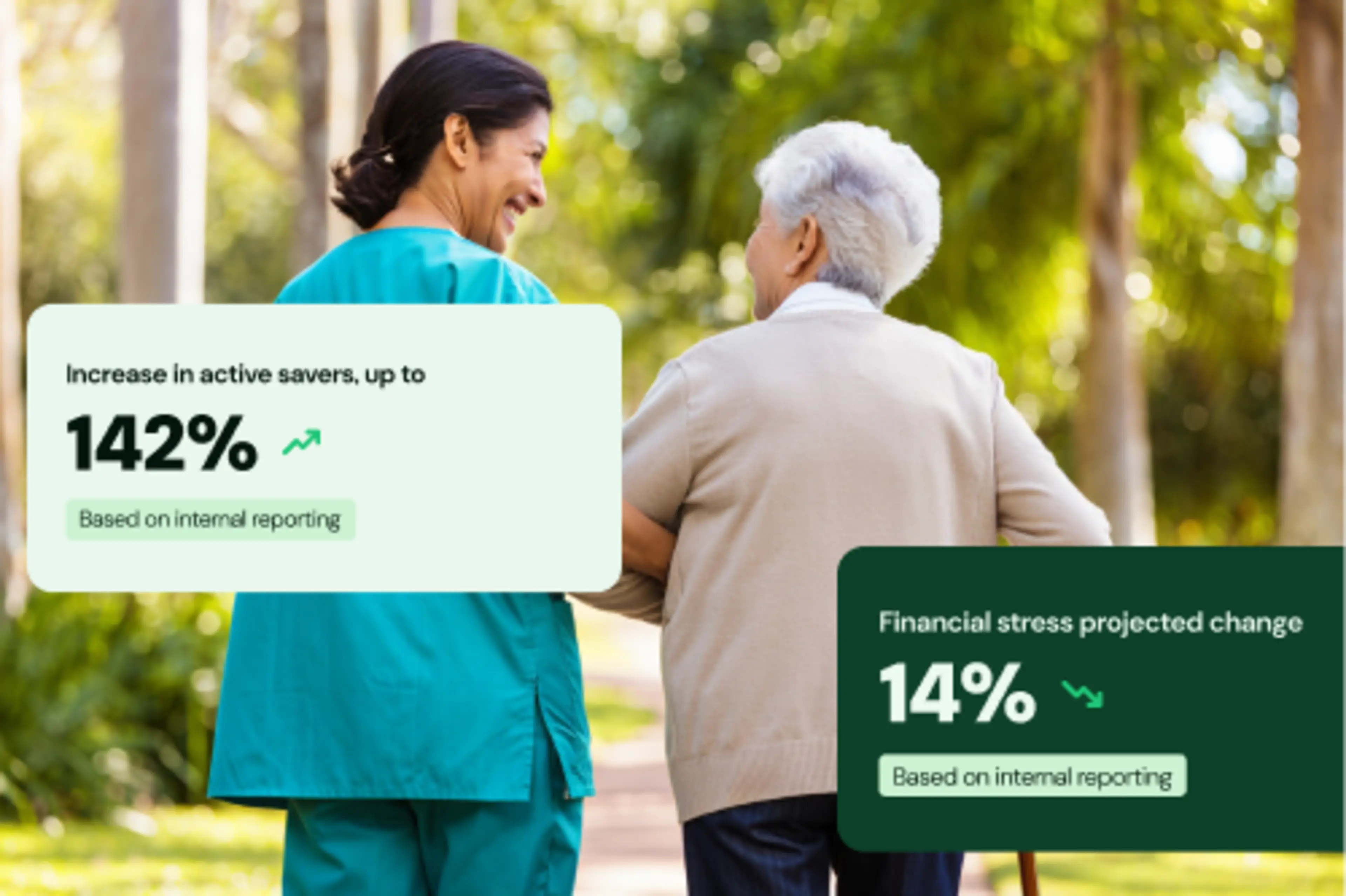
On the measurement side, HR teams track utilization rates, enrollment figures, financial coaching completion, EWA adoption, and financial stress scores before and after program implementation through anonymous employee surveys. Companies taking more responsibility for employee financial wellbeing report higher employee satisfaction scores. (see disclosure 9)
But the gap between potential ROI and proven ROI is where most programs fall short. Everest Group's 2026 research found that 83% of employers say their financial health programs struggle to demonstrate positive, measurable outcomes. (see disclosure 6) The measurement problem is specific: 66% of employers who have adopted financial wellness cannot effectively measure employee financial stress, 48% have difficulty tracking behavioral changes in employee financial habits, and 35% cannot connect program usage to employee retention or turnover at all. (see disclosure 6)
The ROI is there to be captured, but only for organizations that build measurement infrastructure into their programs from the start rather than trying to retrofit it after the fact. Enter modern financial wellness platforms that now deploy employer dashboards to track workforce financial health. On an anonymized basis, employers can see if the program is actually driving improvements in saving, credit health and financial stress.
From Corporate Profitability to Employee Financial Wellness
The migration of the term corporate financial health and wellness from the finance world to the HR world is more than a semantic curiosity. It reflects a genuine and significant shift in how employers understand their relationship to employee financial health. It is now a business variable with measurable impact on productivity, retention, and organizational performance. The organizations ahead of the curve are treating corporate financial wellness not as a benefit category to check off, but as a workforce strategy with a measurable business case.
Support your employees’ financial health
Chime Workplace™ is built for organizations that understand corporate financial wellness in its modern form — not as a category to check off, but as a workforce strategy with a real business case. Book a demo to learn about delivering a robust financial-wellness ecosystem that helps employees make genuine progress, and gives HR teams the data to measure it.