
Chime Workplace recently brought together a group of senior HR and operations leaders in Dallas for a candid executive roundtable. No topic dominated the conversation more than how AI is reshaping their workplaces. Around the table: a director of HR supply chain from a national sporting goods retailer, a corporate HR director from a large hospital system, a VP of talent from a logistics company, an SVP of total rewards from a fast-growing restaurant chain, and a head of global payroll from a Fortune 10 healthcare distributor, among others. Each running a complex, frontline-heavy business. Each navigating the same question from a different angle: Where is AI actually taking us and how do we lead through it?
Why Pressure to Use AI Is Growing in HR Industry
The question is coming from every direction. Boards want a strategy. CEOs want proof of progress. And HR leaders are being tasked with implementing a transformation they’re still defining.
What’s striking is how universal the pressure feels across industries. A payroll leader at a healthcare distribution company and an HR director at a juice bar chain are fielding similar questions from their executive teams. The difference is that some organizations have responded by mandating AI goals for every senior leader. This has created a different problem: lots of activity, not much alignment.
One leader described it plainly:
We did a good job solving a lot of little problems with AI. We’ve done a really bad job solving the right big problems.
The Costly Mistake HR Teams Keep Making With AI
Before any conversation about which AI tools to use, the conversation kept returning to the same warning: If you automate a broken process, you don’t fix it. You just fail faster.
The instinct to layer technology on top of existing workflows is understandable. But the organizations seeing real returns are the ones that mapped the work first. That means identifying where the actual friction lives, what decisions need to be made and by whom, and what would have to change before any tool could help. One payroll leader described spending significant time tracing the full journey from time clock to paycheck before touching a single piece of technology.
The formula that came up: New technology plus an old broken process equals a more expensive broken process. The discipline is in resisting the shortcut.
New technology plus an old broken process equals a more expensive broken process.
AI Tools HR and Operations Leaders Are Using Now
When the conversation moved to what’s actually working, the examples that surfaced weren’t grand transformation stories. They were specific, practical, and often modest in scope. Below is what practitioners described in addition to the broader category of tools available in each area.
Recruiting and Talent Acquisition
For lean HR teams growing fast without enough staff to keep up, general-purpose AI assistants like ChatGPT have become a first-draft engine. A job description that used to take an afternoon can be generated in under ten minutes, reviewed, and made usable. For organizations running high-volume hourly hiring, purpose-built AI video screening and candidate assessment tools go further. They conduct structured interviews at scale and analyze responses for role fit before a human recruiter gets involved, cutting time-to-hire significantly, especially in QSR, retail, and healthcare environments where speed directly affects operations (e.g. HireVue). Conversational recruiting assistants handle scheduling and initial screening via text or chat, removing the back-and-forth that slows down frontline hiring (e.g. Paradox/Olivia).
Employee Communications and Content
Two practical uses came up in employee communications. The first: running email drafts through tools like Gemini before sending. The second: using AI to condense and rewrite employee-facing documents. One HR leader reduced a 78-page handbook into something frontline workers would actually read, and took it further by converting key policy content into 90-second videos for a workforce that doesn’t sit at a desk. For teams that want a tool trained specifically on HR outcomes, AI writing platforms built for HR content flag language in job postings and performance reviews that inadvertently drives away candidates or creates legal exposure (e.g. Textio).
Frontline Self-Service and HR Operations
One example cited is a custom AI agent built for hourly and shift workers that handled password resets and time-off requests conversationally — eliminating roughly $1M in annual IT labor cost and removing the need for weekend HR staffing. Password resets that used to take 25 minutes of IT time per incident now resolve instantly. Time-off requests that required navigating a complex HR system were reduced to a plain-language exchange with the agent. For organizations that want this capability without building it from scratch, off-the-shelf HR service desk AI agents integrate with existing HR systems and handle the most common employee requests at any hour (e.g. Moveworks, Leena AI).
Workforce Scheduling and Labor Management
In healthcare, AI-driven dynamic scheduling is one of the highest-impact operational uses. By matching nursing staff to real-time patient volume, you can reduce coverage gaps without adding headcount. The goal isn’t just greater efficiency for its own sake but also patient satisfaction by making sure the right person is in the right place. The same category of tools applies across distribution, food service, and retail: AI-powered workforce scheduling and labor forecasting platforms predict staffing needs based on demand signals like foot traffic, order volume, or census data and auto-generate compliant schedules (e.g. UKG, Quinyx). For organizations managing large hourly workforces with high schedule variability, shift optimization tools match individual employee availability and preferences to real-time business demand, reducing last-minute callouts and the manual scramble that follows (e.g. Legion Technologies).
Attendance and Absence Management
One of the most effective solutions requires no AI model at all. A QR code-based digital call-out system built on Microsoft infrastructure replaced a manual call-in process that had consumed one person’s full workday and had become the highest-turnover role in the organization. Employees scan, log an absence reason, and indicate whether documentation is coming. The data flows automatically into a dashboard that surfaces attendance trends. The lesson: before reaching for AI, ask whether a simpler automation solves the same problem faster.
Payroll Intelligence and Compliance Monitoring
The time clock-to-paycheck journey was identified as a major area of operational complexity, particularly for organizations with large hourly workforces across multiple locations, pay types, and jurisdictions. Mapping that process end-to-end, before touching any technology is foundational. AI-driven payroll anomaly detection and compliance monitoring tools build on that foundation by scanning payroll data before processing runs to flag errors and jurisdiction-specific compliance risks. This identifies problems before they become employee complaints or regulatory exposure (e.g. Immedis, CloudPay).
Workforce Development and Internal Mobility
As AI reshapes what roles require, reskilling moves from an HR initiative to an operational necessity. Microlearning platforms built for frontline workers deliver short, personalized training in 3-5 minute bursts via mobile, adapting content over time based on individual knowledge gaps — designed for workforces that can’t stop for a training day (e.g. Axonify). For organizations managing internal mobility at scale, AI-powered talent intelligence platforms match existing employees to open roles based on skills rather than job titles, surfacing redeployment opportunities before the organization defaults to a backfill or a layoff (e.g. Eightfold AI).
Financial Wellness with Embedded AI
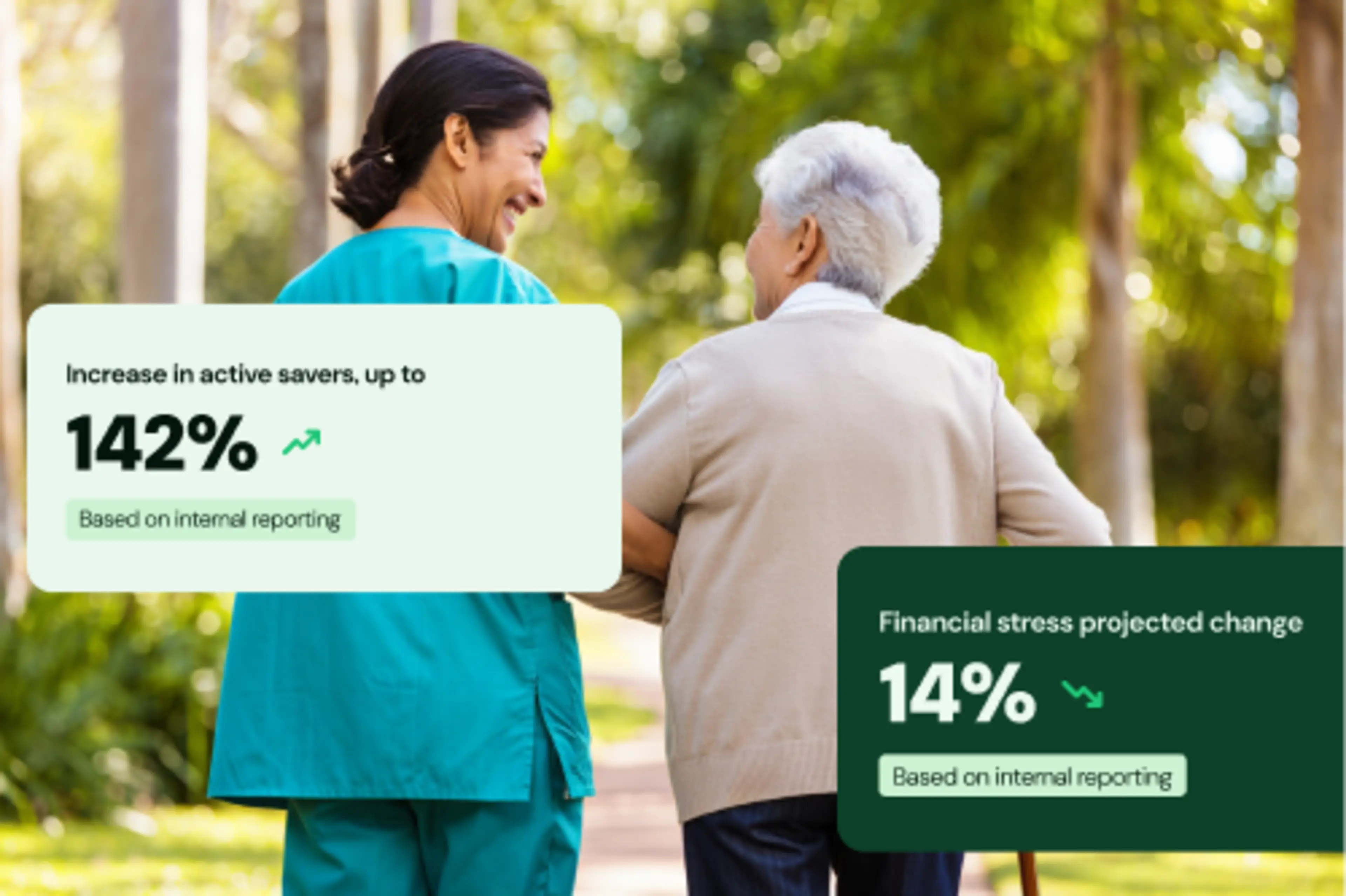
One of the fastest growing benefits is financial wellness, with more than three-quarters of enterprises rating it as a strategic priority in the next twelve months. At the vanguard are financial wellness platforms that are embedding AI to help employees make financial progress. Chime’s AI co-pilot will nudge workers towards better financial decisions, from paying off high-interest credit cards to improving savings habits. Two-thirds1 of Americans who have used generative AI report they now use AI for financial advice. So as AI adoption increases, more employees will be looking for it to be embedded in their financial benefits.
Why Employees Resist AI Adoption — and What HR Leaders Do About It
Technology is rarely the hard part. Getting people to use it is.
Resistance to AI shows up in predictable ways: fear of job loss, suspicion of outputs, reluctance to change a workflow that already works well enough. HR leaders are dealing with this across every level of their organizations — from frontline workers who wonder if they’re training their replacement, to experienced managers who feel they’re being asked to trust a tool they don’t understand.
The reframe that worked best: this is about skills, not jobs. When the automobile replaced the horse, someone still had to build the engine, repair it, and eventually design a better one. AI changes what a role requires. It doesn’t erase the need for people who can make decisions, read a room, or do the work that requires being human.
What accelerates adoption in practice: starting with managers before rolling anything out to teams, giving people clear examples of what the tool does in their specific job, and creating room to experiment without consequence. The organizations with real momentum are the ones where leadership is visibly using AI themselves — not just mandating it.
Is AI Eliminating HR and Operations Jobs? An Honest Answer
Most of the conversation about AI in HR stays carefully optimistic: it's about freeing people up, not replacing them. But that framing doesn't hold everywhere. In healthcare, organizations have already reduced headcount in roles like revenue cycle coding and accounts payable — high-volume transactional work that AI now handles more efficiently. Those positions are gone, with no backfill.
That’s a real data point, and it deserves to be named. But it sits inside a larger and more complicated picture.
For some of the companies, AI is absorbing specific tasks within roles, not eliminating the roles themselves. The capacity it frees up is being redirected: to higher-judgment work, to employee-facing initiatives, to the problems that actually needed a person all along but never got one because everyone was too busy with the transactional volume.
The honest caveat: what’s true for a growing company is not necessarily true for one in cost-cutting mode. When the business is contracting, efficiency gains translate directly into headcount reductions. The technology doesn’t change. The business context does. That distinction matters, and leaders who are communicating honestly about AI with their teams need to hold both realities at once.
How to Make AI Adoption A Success
After a full evening of conversation across very different organizations and industries, the clearest differentiator wasn’t the technology stack, the budget, or the sophistication of the AI strategy.
It was the quality of the question being asked.
The leaders making real progress had stopped asking “What can AI do?” and started asking “What’s the most expensive problem we haven’t solved yet — and does AI have anything to do with fixing it?” Those are different questions. The first one leads to a tool evaluation. The second one leads to a business decision.
They also shared a habit of working backwards. Start with the outcome the business needs — a growth number, a retention target, a cost threshold. Identify who and what has to change for that outcome to be reachable. Then figure out where AI makes that change faster, cheaper, or more consistent. Not the other way around.
The window to get ahead of this is real and it is closing. The gap between organizations that are building on what they’ve learned and those still waiting for a perfect strategy may be widening. For most of the leaders in that room, that may be how they got to where they are.
Curious About AI-Supported Financial Wellness?
Like the best AI tools, effective benefits solutions can help move the needle for HR leaders and their employees. Chime Workplace’s AI co-pilot is part of a holistic financial wellness platform that supports employee progress, without adding complexity for HR teams. Request a demo now.
This guide is for informational purposes only. Chime does not provide financial, legal, or tax advice. You should check with your legal, financial, or tax advisor for advice specific to your situation.