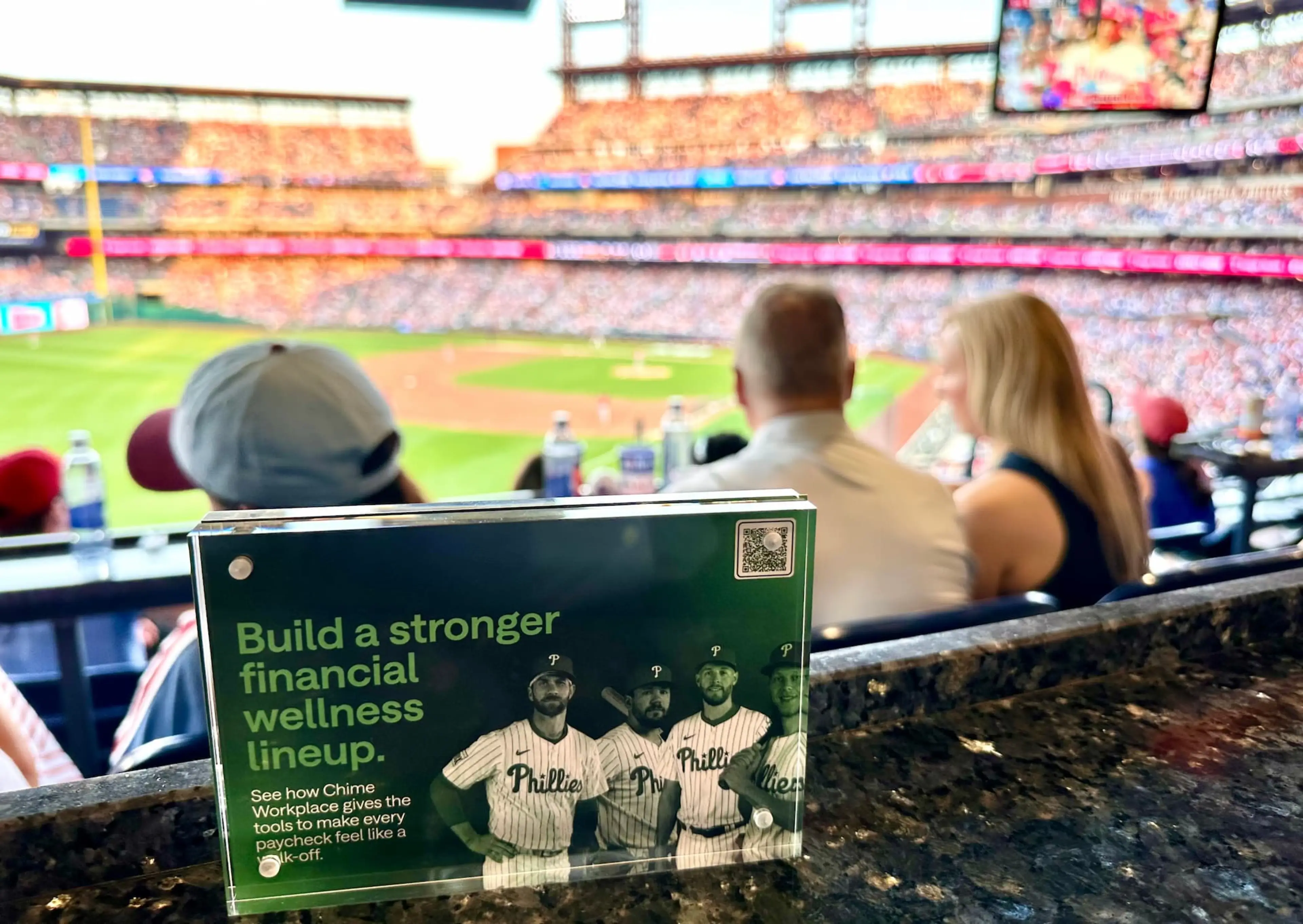
Chime WorkplaceTM and Workday recently hosted an executive roundtable on “AI disruption for frontline workforces,” featuring nearly 20 leaders across HR, People & Talent, and Payroll who also came together for a Phillies game this May. Andrew McMannis, Sr. Principal of Strategic Customer Engagement - AI Strategy at Workday, led the discussion.
I'll be upfront: I don't usually walk away from roundtables surprised. After years of moderating conversations with HR, payroll, and systems leaders, I've gotten good at predicting the talking points. AI efficiency. Governance frameworks. Change management. The usual. This one was different.
Featuring leaders from Cigna to the University of Delaware, hospitality operators to frontline workforce managers — the room felt less like an industry panel and more like a group of leaders who'd been waiting for permission to be honest. And once they started, they didn't stop.
Here's what I heard from real executives about leading AI adoption for their frontline and hourly workforces, from universal challenges to thoughtful policy wins.
Shadow AI Is Already Inside Your Workforce
One CIO shared, "Half of our workforce was using Claude in a non-sanctioned environment." The real-life example is the kind of thing that turns an AI budget conversation into a security conversation overnight.
The pattern is everywhere. Jen Judy, an HR professional at the University of Delaware, described exactly this dynamic: "Everybody's putting inputs into this thing from their open experiences at the university — their school work, the things we're building — and it's learning about us, but it's not data that was protected in the right way."
And because people are using these AI tools productively, it makes it nearly impossible to just say no to using them. The university is grappling with student use the same way enterprises are struggling to contain employees who've found a workflow that works.
Rather than prohibition, the answer is building sanctioned interfaces with the same ease and power that's driving people to the unsanctioned ones.

Human-in-the-Loop AI in Regulated Industries
Jim O'Brien, VP of Network and Benefit Solutions at Cigna Healthcare, noted, "There's been a lot of news stories out there that, like, we're letting AI go run rampant as an industry. That's not the case at all." In fact, he said, "We have a policy where AI, anytime it's customer-facing, has to go through a person. It facilitates — if a doctor needs help, they can get information from AI, but ultimately the doctor is making the decision."
The conversation that followed unpacked why this matters technically, not just ethically. LLMs are probabilistic by nature — ask the same question three times, get three different answers. The governance structure Cigna has built isn't just about liability. It's about recognizing that some decisions require deterministic judgment.
The insight: pairing AI's pattern recognition with human accountability is the architecture that makes it work.
Why Frontline Workers Fear AI Replacement — and Managers Stay Silent
This was the most candid thread of the afternoon. One operations leader working with a large, diverse frontline population, including home-service technicians, described it plainly: "There is this fear of being obsolete. So much of their value has been on the tenure that they have, how they know how to work the systems."
What makes this harder is that the fear doesn't resolve itself through communication alone. As Jen Judy noted about a meeting gone wrong at the University of Delaware: A vendor presented a grid of "things that could be automated" — and several employees saw their own roles highlighted. "The only thing those people remembered after this meeting was: I'm gone. I'm the event planner and I'm done," Judy said.
Her takeaway was clear: "Knowing that you've got employee engagement, or just the understanding of the values and purpose of your organization and where that human element is — that is really critical and necessary."
To that end, she added a warning about managers being uncomfortable with the conversation. "If managers are afraid to talk about it themselves, then there's no conversation, and the people just assume they might go that direction."
Peer-to-Peer AI Adoption Is More Powerful Than Top-Down Rollout
Several leaders independently landed on the same observation: The fastest adoption they've seen didn't come from mandates, but from one person showing a coworker something cool.
Lauren Schmidt, who leads talent strategic initiatives at Comcast, shared "I've found in a sales environment — one of the reps is like, 'Hey, I just figured out how to do all the research. Here's the prompt.' And then they show it, and everyone watches and adopts it immediately."
The strategic implication is significant: Leaders don't have to be the champions. They have to create the conditions for champions to emerge — and then get out of the way. Safe sharing, recognized experimentation, and celebrating the person who found the better prompt matters more than the top-down launch email.
Tie AI Adoption to Performance Metrics, Not Time Saved
There was a useful distinction made between two adoption environments: corporate and frontline.
On the corporate side, it's easy to save a few minutes on email, and easy to spend those same minutes going down a rabbit hole. The productivity gains don't always compound. On the frontline, the calculus is different. As Lauren Schmidt observed, "When you tie [employees’] sales performance to the use of the tools, that's when you really start to see the adoption."
The message to leaders: “Time saved” metrics aren't enough. If a technician can reach more appointments per day, that's an outcome. If a claims processor can reduce turnaround from five days to one, that's an outcome. Minutes saved at a desk don't automatically become business results, but connecting AI adoption to real performance levers does.
Upskilling a Workforce After AI Automation
One of the more memorable moments of the afternoon was the IKEA example shared by co-host Andrew McMannis, a case study in what happens when AI displacement is treated as a design problem, not a headcount problem.
IKEA automated their customer service function with an AI agent, McMannis explained. That meant a large population of customer service workers no longer had their original role. Rather than part ways with them, leadership asked: What can we do now that we couldn't do before?
The answer was interior design services. Using AI tools to analyze purchase history and make personalized design recommendations, they upskilled their customer service workforce into a design function, and unlocked an entirely new revenue stream in the process.
The takeaway for the room, in McMannis’ words: "How do we fund [AI adoption]? It doesn't always have to be in productivity or headcount reduction. What areas does it open up for you strategically as a business to be able to pursue and do more?"
Why Enterprise AI Pilots Fail: Three Common Patterns
Drawing on engagements across the various organizations represented, three failure modes came up consistently:
1. Scope is too narrow, and disconnected from strategy. Narrow use cases need to be explicitly linked to bigger outcomes, — or they die in year one. Automating interview scheduling is fine. But if the CIO can't connect it to a strategic business objective when reporting to the board, it's a pilot that never becomes a program.
2. Fragmented systems and no orchestration layer. Enterprise tech ecosystems typically have 20 to 30 systems of record. Each one has its own embedded AI experience. Without an orchestration layer, a single front door, employees are left toggling between tools while adoption craters. As one participant put it, "If you're continually throwing a new agent at users every month, you're going to lose the trust of your workforce. They'll say, 'Why am I even going to use this?'"
3. ROI that doesn't translate to organizational outcomes. Giving someone back 80% of an hour doesn't mean the organization gets 80% more output. "If you're giving me back 80 percent of an hour in my day, it doesn't mean I'm going to automatically do more work as an employee. I may go take my dog for a walk," McMannis noted. The measurement framework has to track downstream business metrics, such as customer throughput, error rates, retention, not just time saved.
Measuring AI ROI: Efficiency Gains vs. New Business Opportunities
Cigna’s Jim O'Brien framed the ROI landscape in a way that stuck with the room: There are two buckets. The first is classic automation ROI — before and after efficiency metrics. Measurable, defensible, reportable. "How efficient are you getting? How much time did it take before, how much does it take now?" Cigna has pilots running in this category that are already successful.
The second is what he called the innovation category: "Stuff that we weren't able to do before. Wouldn't it be interesting if we could do this?" His example was loading Cigna's in-network physician directories into ChatGPT so that members searching for a podiatrist can find in-network providers where they already are, rather than being sent back to a proprietary app. "We know that's where people are going,” he said. “All of a sudden that information becomes available and it's actually getting used."
Two different problems. Two different measurement frameworks. Organizations that conflate them often undervalue the second category until a competitor demonstrates it at scale.
Bring Employees Along: The Human Side of AI Implementation
If there was one consensus that emerged from the afternoon, it was that AI implementation done in a vacuum is destined for distrust.
Whether it's co-designing workflows with frontline technicians, running workshops where employees prompt AI to explain how it could eliminate their own job (yes, someone in the room actually did this, and said it was illuminating), or simply making sure managers are equipped to have the hard conversation before employees start assuming the worst, the human dimension isn't a soft factor. It's the implementation variable that determines whether any of the technology actually sticks.
You almost have to sit there and brainstorm with them,” McMannis said. “You can't do it sitting in an ivory tower saying, 'This is what you should be doing now.'
That's the work. And frankly, it's the part that no AI tool can do for you.
Thank you to everyone who joined us for this conversation. your candor made it worth having. Special thanks to Workday and Chime Workplace for hosting us together in Philadelphia.
Support Frontline Workers Through Change
Successful AI adoption hinges on bringing employees along, especially for hourly and frontline workforces navigating real financial stress. Chime Workplace helps employers provide financial-foundation building tools that help keep workers engaged, stable, and ready for what's next. Book a demo to see how it works.