

Earned wage access (EWA) programs have become more widely adopted as employers expand financial wellness offerings. As organizations scale these programs, operational infrastructure is becoming an increasingly important consideration in how programs function over time.
Research from the Everest Group’s 2026 study on earned wage access indicates that 79% of enterprises identify payroll integration as a key area for improvement within their EWA programs. This reflects how organizations are evaluating the operational requirements needed to support these programs at scale.
For HR and payroll leaders, EWA programs are often introduced as employee benefits. Over time, their effectiveness may be influenced by how well they integrate with payroll systems that manage earnings, eligibility, and pay distribution.
When payroll integration is limited or inconsistent, operational friction can arise in some cases. In some cases, these challenges can relate to employee experience, administrative workload, and program adoption over time.
Understanding the role payroll integration plays can help organizations evaluate EWA providers and design programs that are designed to operate more consistently within existing payroll environments.
Why Payroll Integration Matters for Earned Wage Access Programs
Earned wage access programs rely on accurate and timely earnings data. Without reliable integration with payroll and workforce systems, EWA platforms can experience challenges related to balance accuracy, eligibility status, or reconciliation processes.
In practice, this means that payroll integration influences several core operational functions, including:
Earnings visibility
Eligibility verification
Payroll reconciliation
Employer reporting and oversight
Programs built as standalone systems layered on top of payroll infrastructure may introduce operational challenges such as:
Delayed eligibility updates
Manual reconciliation work
Inconsistent employee access across pay groups
Limited employer visibility into program activity
These issues do not necessarily appear immediately. They often surface gradually through support requests, reconciliation discrepancies, or employee confusion about available balances.
For payroll teams managing large workforces, even small operational inefficiencies can compound across pay cycles.
Operational Risks of Poor EWA Payroll Integration
When payroll integration is incomplete, operational friction can affect both employers and employees.
1. Earnings Data Accuracy
If earnings information does not update reliably, employees could see balances that do not fully reflect recently worked hours.
In some cases this can lead to:
Declined transactions
Support inquiries
Confusion about available funds
Initial user experience can play a role in ongoing engagement with workplace financial tools. When balances appear inconsistent, some employees may be less likely to continue using the program.
2. Administrative Workload for Payroll Teams
Payroll departments are responsible for maintaining accurate pay records, tax reporting, and compliance documentation.
If reconciliation between payroll and EWA systems is not automated, teams may need to manually review:
Advances issued during the pay cycle
Repayment activity
Payroll ledger accuracy
For organizations with thousands of employees enrolled, these processes may require recurring manual review each pay period.
3. Consistency Across Workforce Segments
Workforces often include multiple employee classifications, locations, and pay structures.
Without strong payroll integration, eligibility rules may not apply consistently across:
Hourly vs salaried employees
Different pay frequencies
Regional payroll configurations
Maintaining consistent eligibility across employee groups is often an important consideration for organizations with complex payroll environments.
What Strong Payroll Integration May Look Like
Payroll and HR leaders often evaluate EWA providers based on how their platforms integrate with existing systems. Everest Group research highlights several capabilities that may support more consistent program administration.
Pre-built Payroll and HCM Integrations
Integrations with payroll and workforce platforms may allow earnings data to update automatically, supporting more consistent balance visibility and eligibility determination.
Real-Time or Near-Real-Time Earnings Visibility
Timely earnings data may help employees view balances that reflect recent work activity, which may reduce confusion about available funds.
Automated Payroll Reconciliation
Automation may reduce the need for manual verification of EWA activity during each pay cycle, supporting payroll accuracy while helping manage administrative workload.
Employer Visibility and Reporting
Integration may allow HR and payroll leaders to monitor program activity within existing systems, rather than relying solely on external provider portals.
Understanding Earned Wage Access Repayment Models
Repayment structure is another operational consideration when evaluating EWA providers. When employees access earned wages early, repayment is typically handled through one of several models.
Payroll Deduction Model
The employer processes repayment through payroll by applying a deduction within the employee’s paycheck. The remaining net pay is then distributed to the employee through the standard payroll process. This approach may require configuration of payroll deductions and ongoing payroll team involvement in reconciliation and reporting.
Payroll Intercept Model
Under this structure, the employer sends employee wages to the provider as part of the payroll funding flow before distribution to the employee. The provider then applies repayment and transfers the remaining funds to the employee. This approach may require changes to payroll funding and distribution workflows, depending on employer setup.
Settlement Model
The employer sends the full paycheck directly to the employee through the standard payroll process. Repayment then occurs separately from the employee’s bank account according to program terms. This structure typically does not require changes to payroll distribution processes.
Why Some Employers Consider Provider-Managed Repayment
The Everest Group research found that 72% of enterprises prefer repayment to be managed directly by the provider rather than through payroll.
This preference may reflect the operational considerations payroll teams encounter when repayment flows through payroll systems.
When payroll intercept or deduction models are used, payroll departments may need to:
Track repayment activity
Apply deductions accurately
Respond to employee paystub questions
Maintain additional documentation for record-keeping
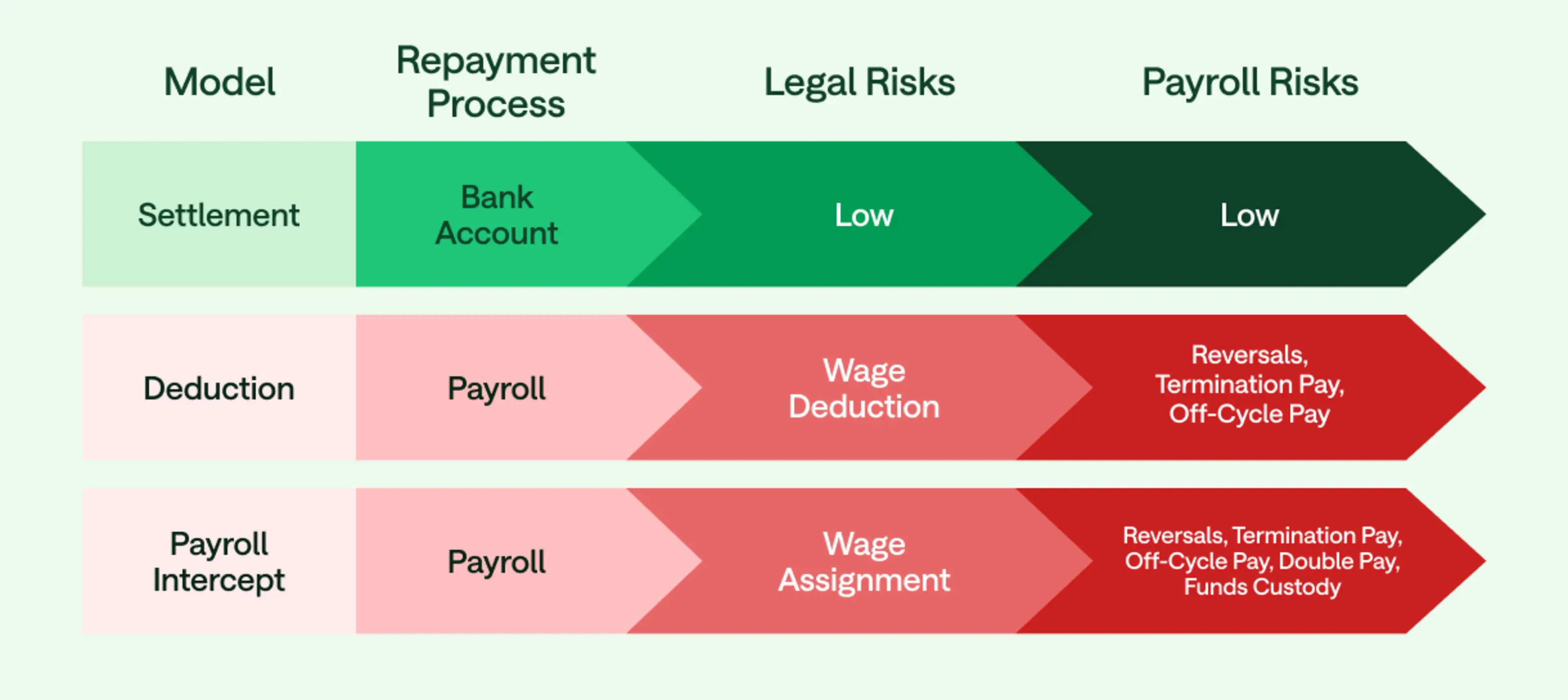
Provider-managed repayment structures may separate repayment from the payroll ledger, which may reduce some administrative steps. In some cases, this structure may also support clearer paystub presentation by maintaining full earnings visibility.
How Operational Friction May Influence Program Experience
Integration and repayment are often viewed as operational details, but they may also shape how programs are experienced by both employees and payroll teams.
Many organizations cite financial wellness as one reason for offering EWA. Program consistency and clarity may play a role in how employees engage with these tools over time.
Some organizations that have not adopted EWA report limited visibility into financial health outcomes. In certain cases, this may be associated with factors such as lower participation, inconsistent access experiences, or employee confusion about available balances.
Integration and repayment structure are operational components that may influence how reliably programs function and how they are perceived across the workforce.
EWA Provider Evaluation Checklist: Payroll Integration and Repayment
The Everest Group findings translate directly into the questions HR and payroll leaders should put to any EWA provider — whether selecting a new solution or reviewing an existing program.
Payroll Integration
• Reliable syncing: Does earnings and eligibility data sync on a consistent, automated cadence (API or scheduled batch), with clear cutoffs to help support balance viability and access timing?
• Automated reconciliation: Is end-to-end reconciliation fully automated, or does your payroll team need to manually verify activity each cycle?
• Workforce coverage: Does the integration support all employee types, pay frequencies, and regional configurations across your organization?
• Implementation scope: What is required from your IT team to go live, and what is the realistic implementation timeline?
• Employer visibility: Can your payroll and HR teams view EWA activity within your existing systems — without accessing a separate provider portal?
Repayment Management
• Provider ownership: Does the provider manage repayment entirely, without any payroll intercept or employer-side deduction processing?
• Payroll ledger integrity: Is repayment structured outside the payroll ledger, so paystubs may reflect full employee compensation more clearly?
• Compliance architecture: Is the repayment model designed with consideration for wage assignment and tax implications?
• Employee paycheck integrity: Does the employee's net paycheck arrive in full, with deductions clearly documented where applicable?
• Audit trail: Does the employer have complete, accessible documentation of all repayment activity for compliance and record-keeping?
Chime Workplace™ offers a financial wellness platform designed to provide employees with access to tools and resources that may support their financial progress over time. To learn more about how Chime Workplace supports employers and their teams, request a demo.